I forgot to mention two things about our little escapade to London last week. Call them my weekend moaning points, served with a side of British politeness.
1. The signal that wasn’t
Phone coverage in London is not improving. You’ll be lucky to get a decent 4G connection, and 5G is more of a rumour than a service. I’m spoiled: in our little corner of south west France I enjoy 5G+ almost everywhere, including places where there are more cows than people. As a committed data glutton, I found myself staring at a loading wheel in one of the world’s great capitals, feeling like I’d been sent back to 2009. The city has everything except the one thing I wanted: a bar of signal that stays put.
2. The allergy question
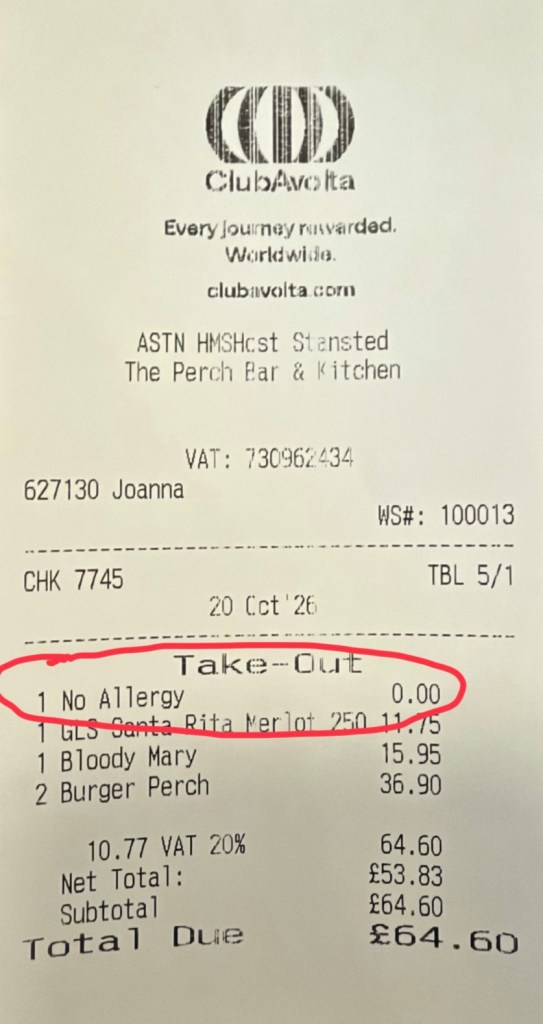
Every restaurant, within seconds of walking in, asks the same thing: “Do you have any allergies?” Sometimes it’s even printed on the bill, just in case you develop one between the starter and dessert.
I understand the reason, and I’m sure it’s saved many lives. But I can’t shake the urge to answer, “We shall find out, won’t we?” It feels like being asked to sign a waiver before the bread basket arrives. I’m told the staff don’t find this funny. I haven’t dared test it.
So there you have it: poor signal and an overly cautious waiter. Rough stuff, I know. These are my moaning points this weekend, and I feel much better for having shared them.
In a spectacular act of self-delusion, I decided last weekend to “start cleaning up the home office.” Anyone who has ever made this announcement knows what it really means: moving things from one pile to a slightly different pile while feeling virtuous about it.
But this time, something happened. I actually opened a couple of boxes that had sat untouched since we moved in nearly ten years ago. They had survived three presidents, two pandemics’ worth of resolutions and a truly heroic amount of dust, and had been quietly maturing like a cheap cheese. Archaeologists would have charged admission.
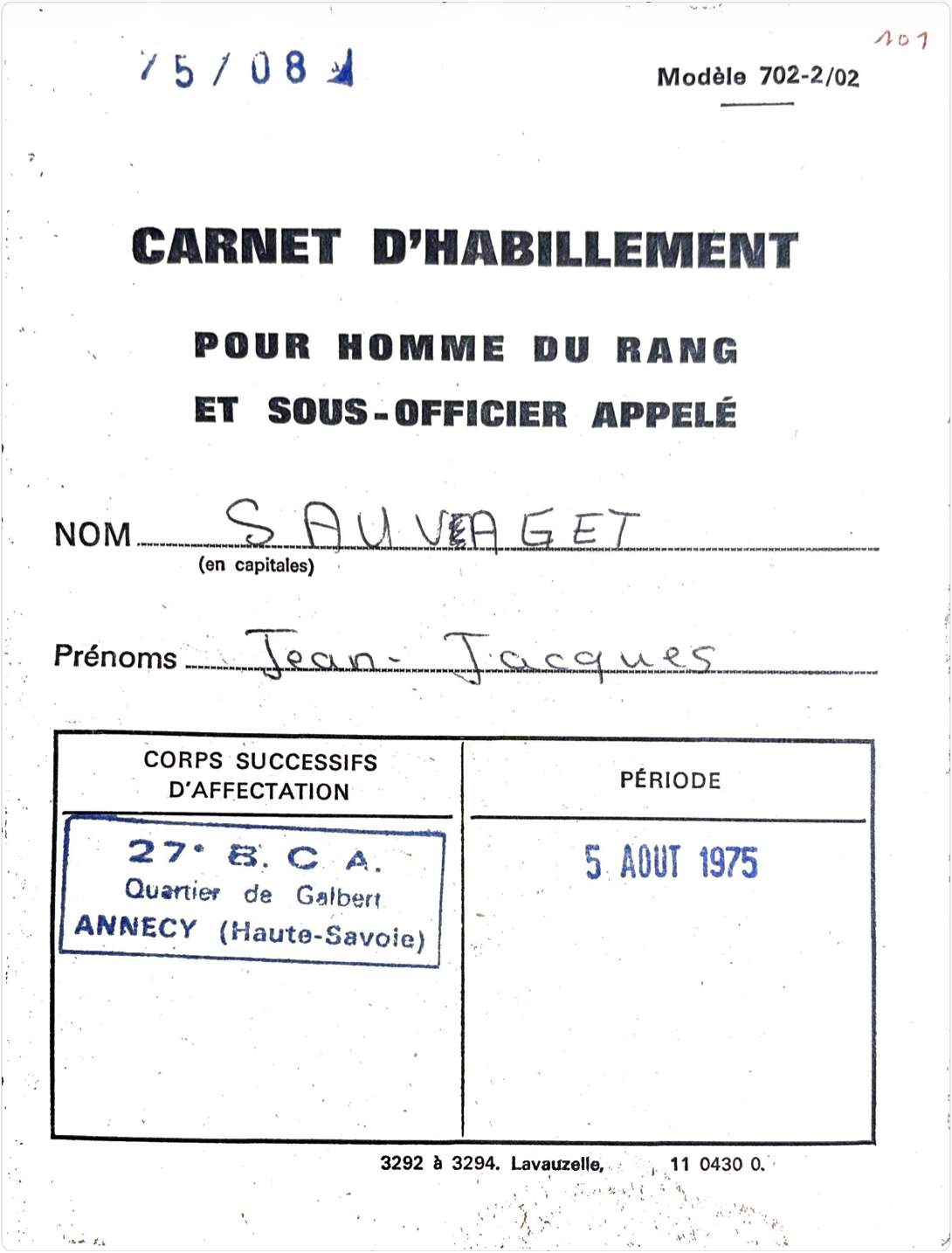
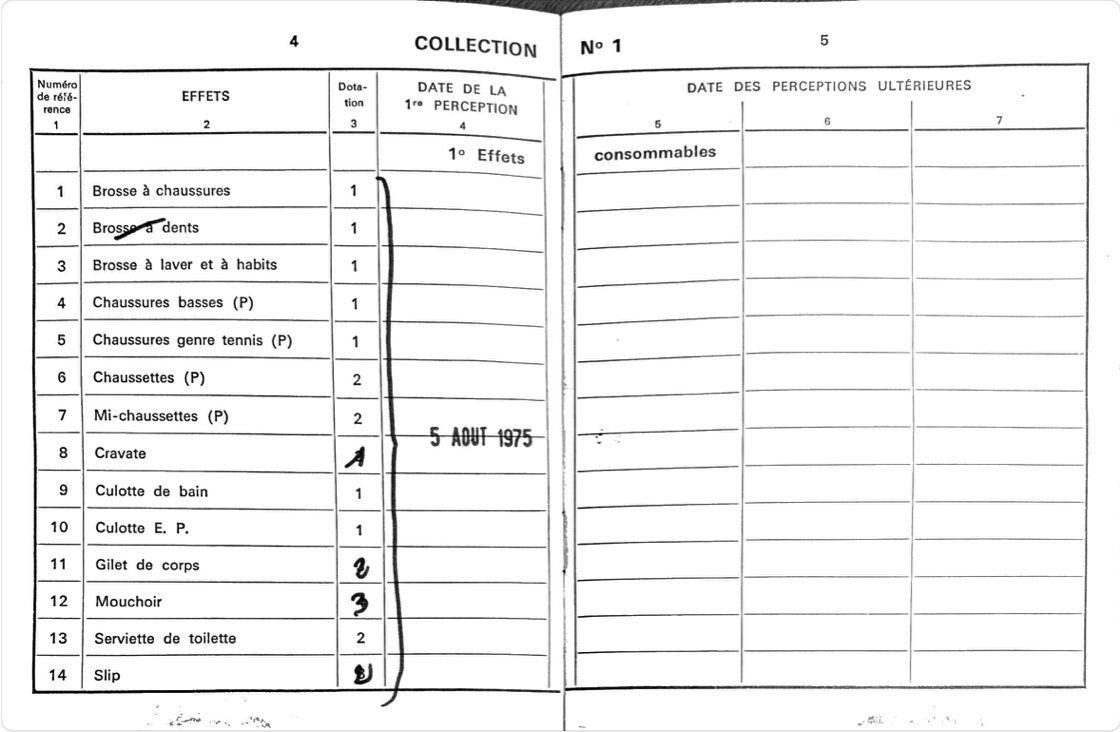
At the bottom of one of them, I found it: my army Carnet d’habillement, August 1975.
For the uninitiated, this is the little booklet in which the military meticulously records every item of clothing and equipment issued to you. Every sock. Every shirt. Every button’s worth of hope that you’ll return it in the condition received. It is the only document in my life that has ever counted my underwear with such seriousness. My bank has never shown such interest.
I scanned it immediately for my digital library, because nothing says “I’m decluttering” like creating a perfect digital copy of something I will never need, and filing it in a folder I will never open. Efficiency!
Reading through it was a trip down memory lane, if memory lane were paved with itchy wool and boots that had apparently been designed by someone who hated feet. There it all was: the uniforms that fit nobody properly, the bits of kit whose purpose was explained once, in a hurry, by someone shouting. Every line brought back a smell, a sound, or a sergeant.
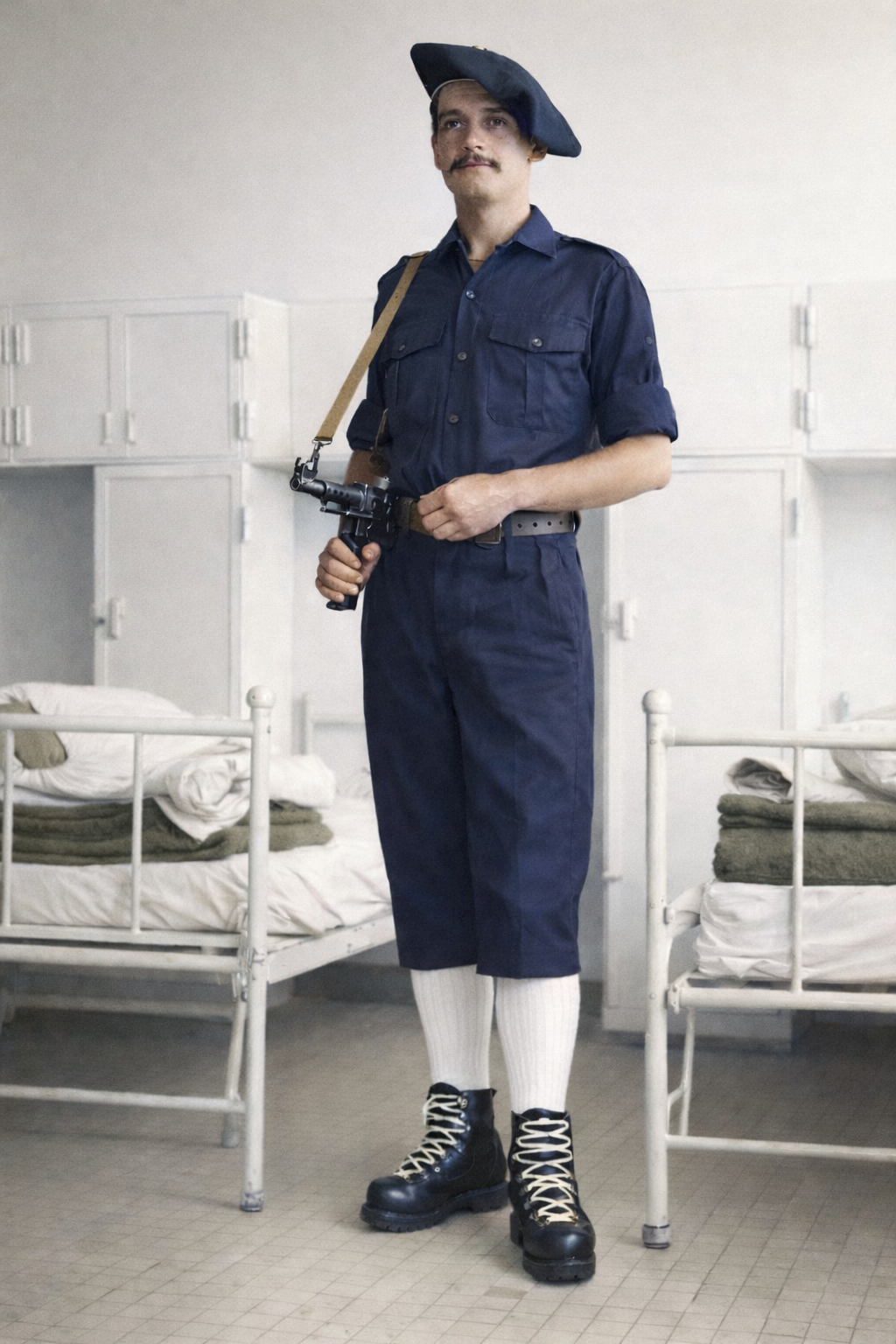
Naturally, everything had to go back. The army, bless its bureaucratic heart, was quite firm on this. You could not keep the trousers. You could not keep the boots. You could not keep the little tin thing that nobody ever understood. The only things I walked away with were the insignia I had earned, which are the military equivalent of a participation trophy, only with more push-ups attached.
And the belt.
Ah, the belt. Somehow, through a clerical oversight, a stroke of cunning, or the quartermaster looking the other way at the right moment (I will never tell), the leather belt stayed with me. And here is the best part: it was not new even then. It had already served some unknown predecessor, possibly through a war, possibly through several bad lunches. It came to me pre-owned, pre-loved and pre-softened.
Fifty years later, I still wear it most days. Fifty years! It has outlasted my hairline, three cars, countless diets, and at least two sets of “I’ll start Monday” resolutions. My waistline has fluctuated like a stock market in turmoil, and yet the belt has stoically adapted, quietly sacrificing a few extra holes without complaint. It has never once judged me. This is more than I can say for my bathroom scale.
There is a lesson here, and it’s a deep one: the army issued me a whole wardrobe, demanded it all back, and the only thing that endured was the one item that was already old. Presumably it also was the only one that never tried to be fashionable.
So the office is not yet clean. The boxes are not yet sorted. But I have a scanned booklet, a head full of memories, and a belt that holds my trousers up with the quiet dignity of half a century of service.
The army may have its records, but I have the belt. And in the end, that’s the only item on the inventory that really matters.
Reporting for duty, as always, at hole number four.
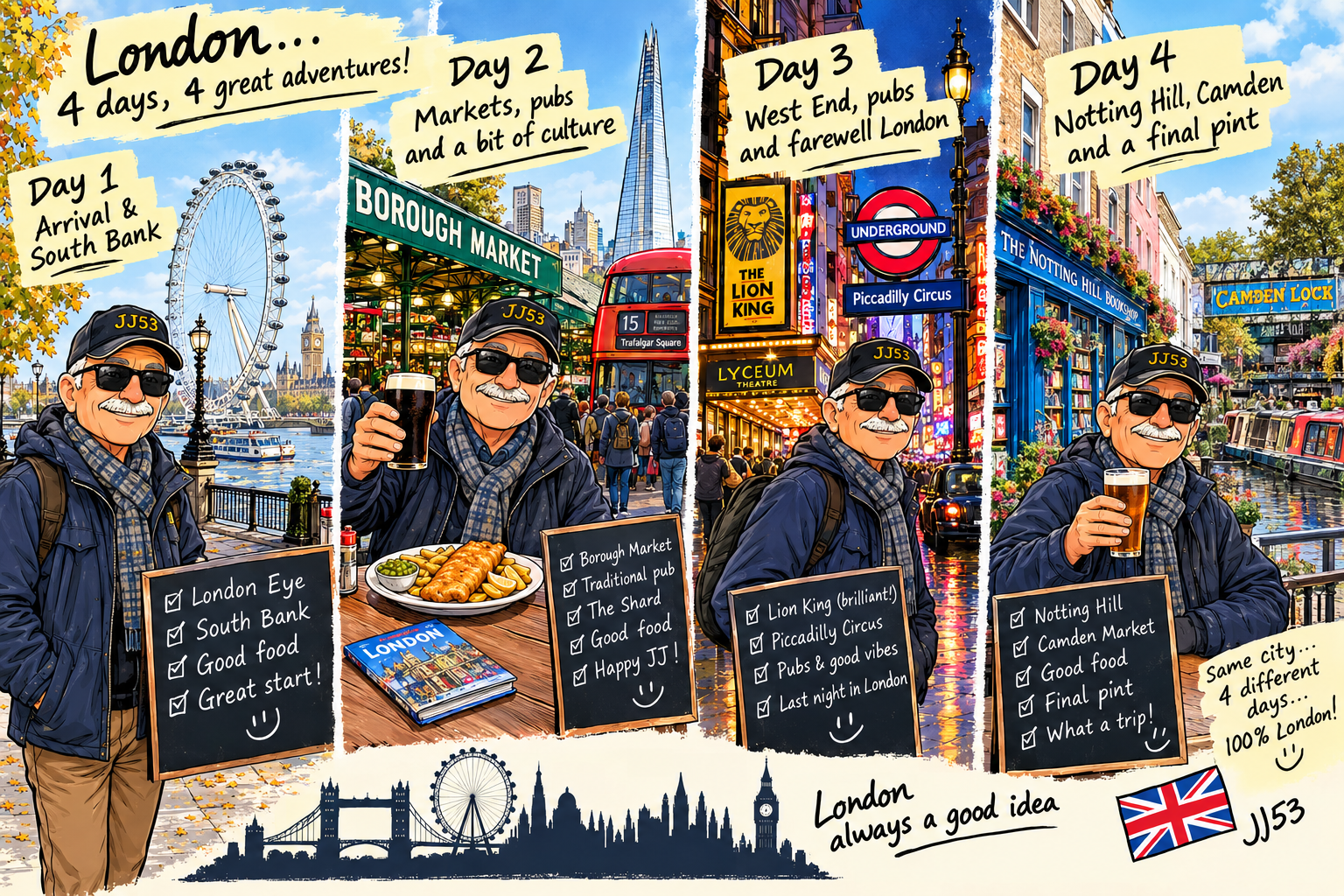
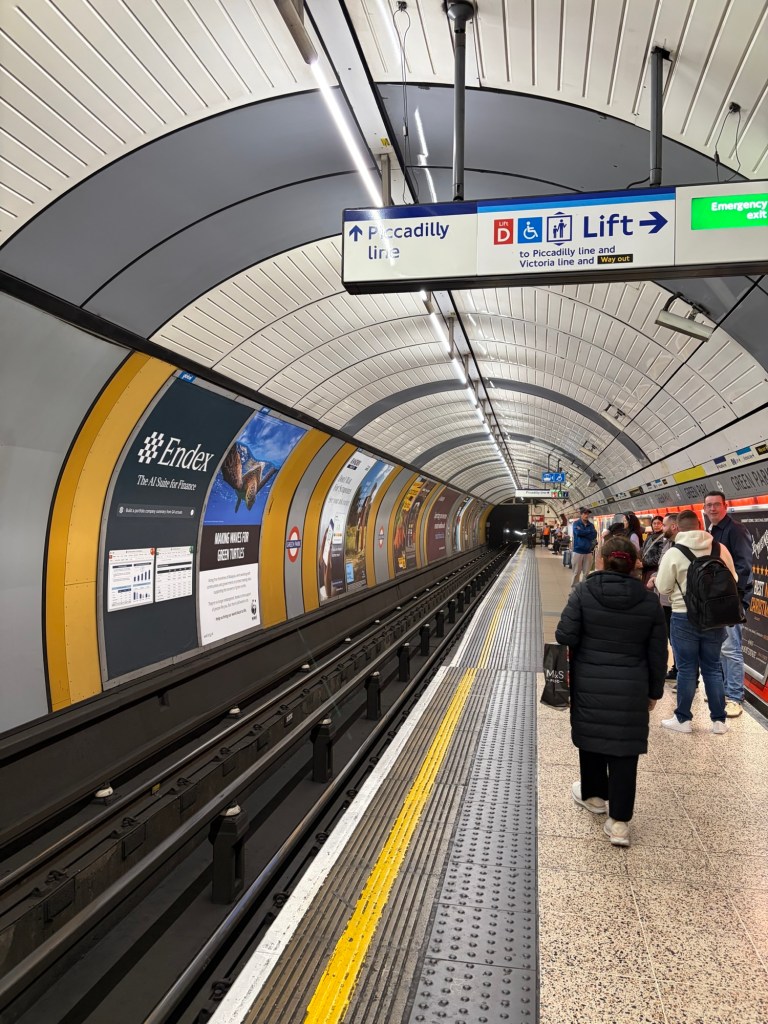
Five days in London, and my carefully prepared itinerary didn’t survive its first encounter with a curry, my feet clocked up kilometres better suited to the London Marathon, pubs mysteriously disappeared whenever I wanted a pint, and a simple Tube journey turned into an expedition to the wrong end of the capital.
Along the way, there was spectacular art, The Lion King, a play that went wonderfully wrong, Chinese food that briefly transported me back to Shanghai, a suspiciously sausage-free sausage roll, and shopping that proved considerably cheaper when done from a sofa in France.
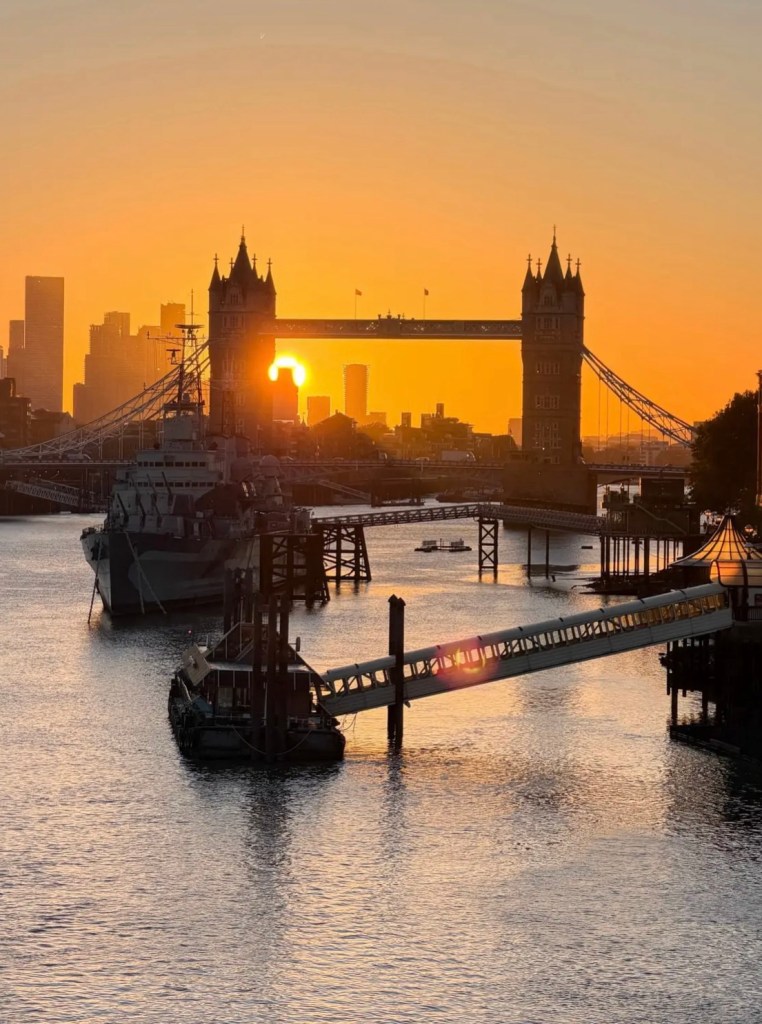
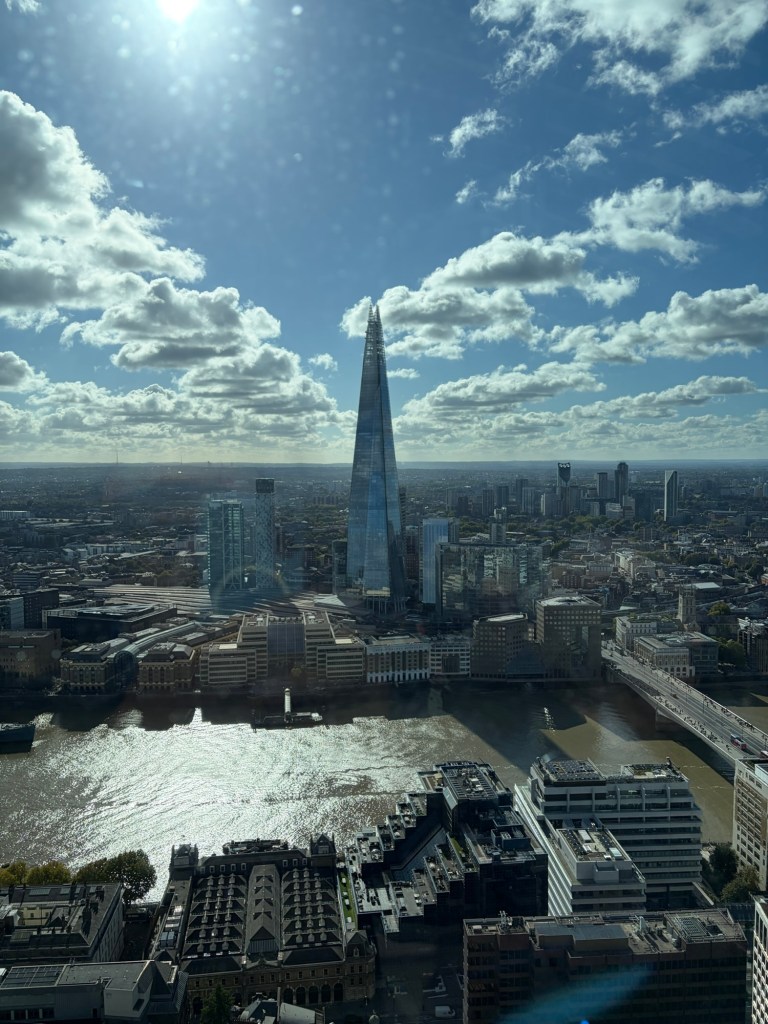
Add a spectacular city skyline, an unexpected foot rebellion, a Ryanair flight that tested the limits of human legroom, and a medicinal pint of London Pride, and you have the perfect recipe for a London adventure.
Did I see everything? Of course not. Did I walk too far, eat too much, sleep too little and visit enough pubs to qualify for honorary membership of the Campaign for Real Ale? Absolutely. London, you’ve been brilliant.
Same time in spring — though next time I’m bringing a map, a larger suitcase, and perhaps a spare pair of feet. 🍺🇬🇧
Good night’s sleep? Check. Foot considerably less painful? Check. I’m giving full credit to the pint of Fuller’s London Pride last night. Medicinal, obviously. Doctors hate this one weird trick.
It’s not even 10am and I’m already on the Stansted Express, waiting to roll out to the airport. Peak efficiency, or just a very committed escape. You decide.
So it’s farewell to London for the second time in three months. Spring, I’ll see you there. Three full, fascinating, wonderfully varied days, and as always, I’ll save the proper reflecting for when I’m back home with a cuppa and my feet up (the better foot, anyway).
Slept until 5am, which at my age is basically a medical miracle. Apparently walking half the Thames Valley will do that to a man.
Today’s plan: a cloth shop on King’s Road, a Chinese lunch, and some “something cultural” in between. Also, London’s last 6pm sunset of the year happened last night. I didn’t see it, but I’m told it was lovely and also a threat.
Then came the Mistake of the Month. I set out for West Ham. I arrived, with great confidence, at West Hampstead. These are not the same place. They are not even the same direction. We rode almost to the end of the line before the penny dropped, which in London is roughly Zone 6 of regret. Then we turned around, like two pensioners who’d taken the wrong coach to Margate.
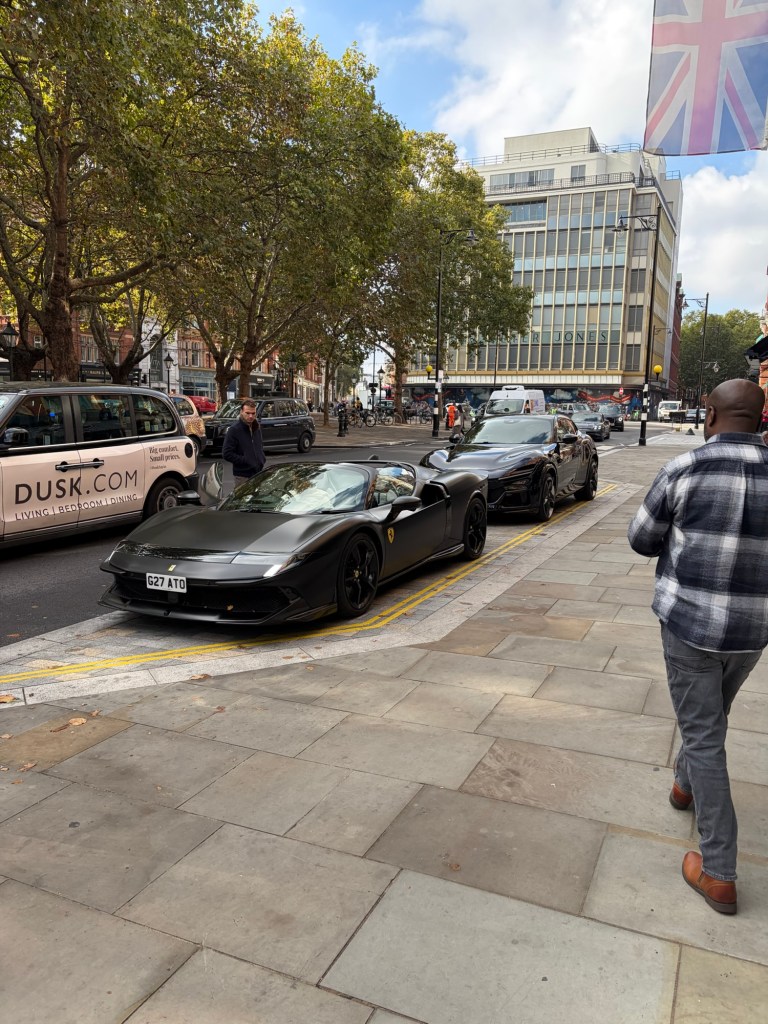
Eventually we reached Sloane Square, home of the other half, the half that parks two Ferraris outside a shop as casually as I park a shopping trolley.
Prices around here have a certain “if you have to ask” quality.
Found the cloth. Admired the cloth. Did not buy the cloth, for two excellent reasons: (1) no room in my hand luggage, and (2) the price was the same as in France, only in pounds instead of euros, which is not a bargain, it’s a magic trick. I’ll buy it online and save 15%, and enjoy the smug glow of a man who outsmarted Sloane Square from his sofa.
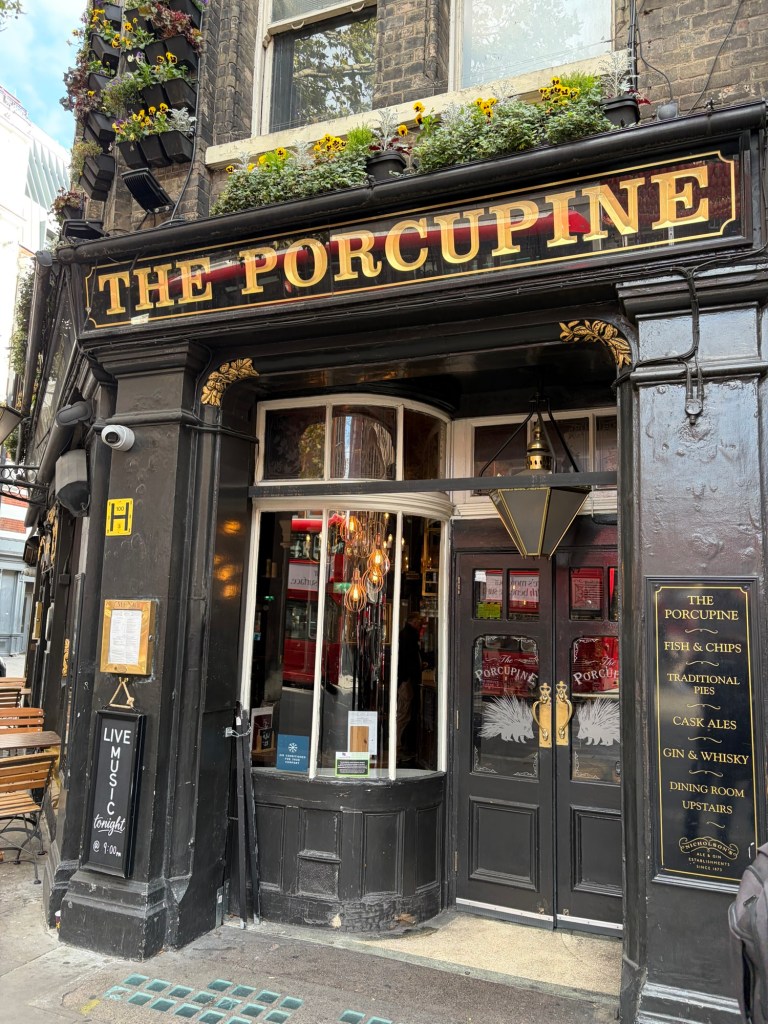
Next, a pre-lunch gin and tonic at the Porcupine near Leicester Square. Every time I’m in London I end up here. At this point I suspect it isn’t a pub but a gravitational field.
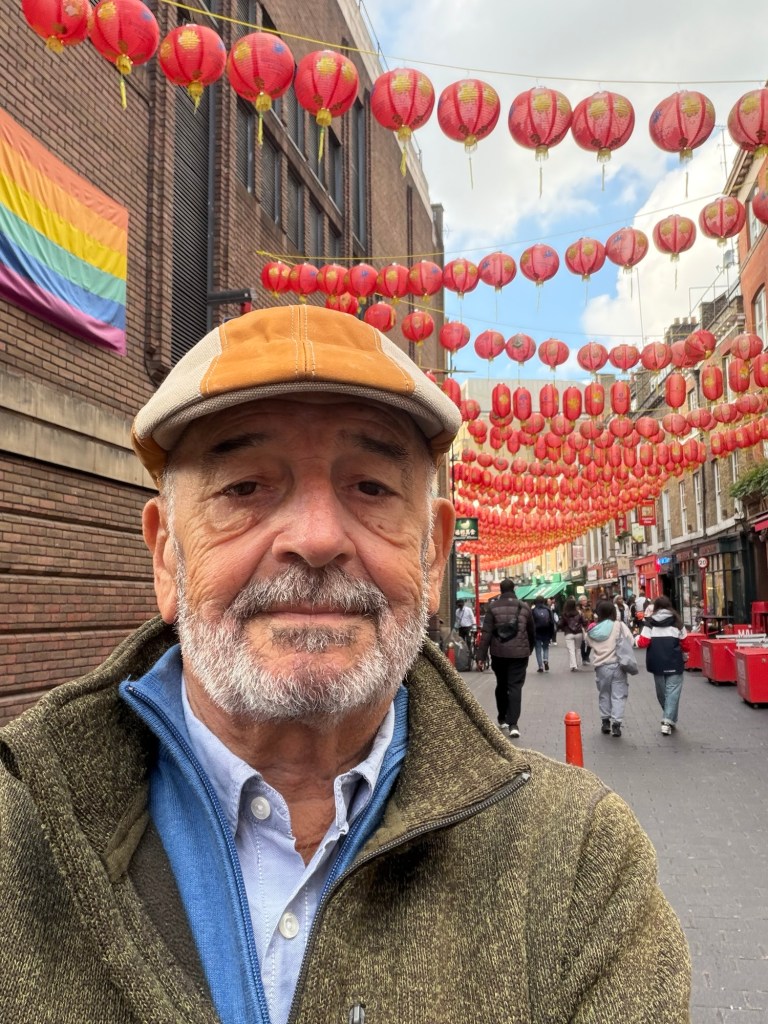
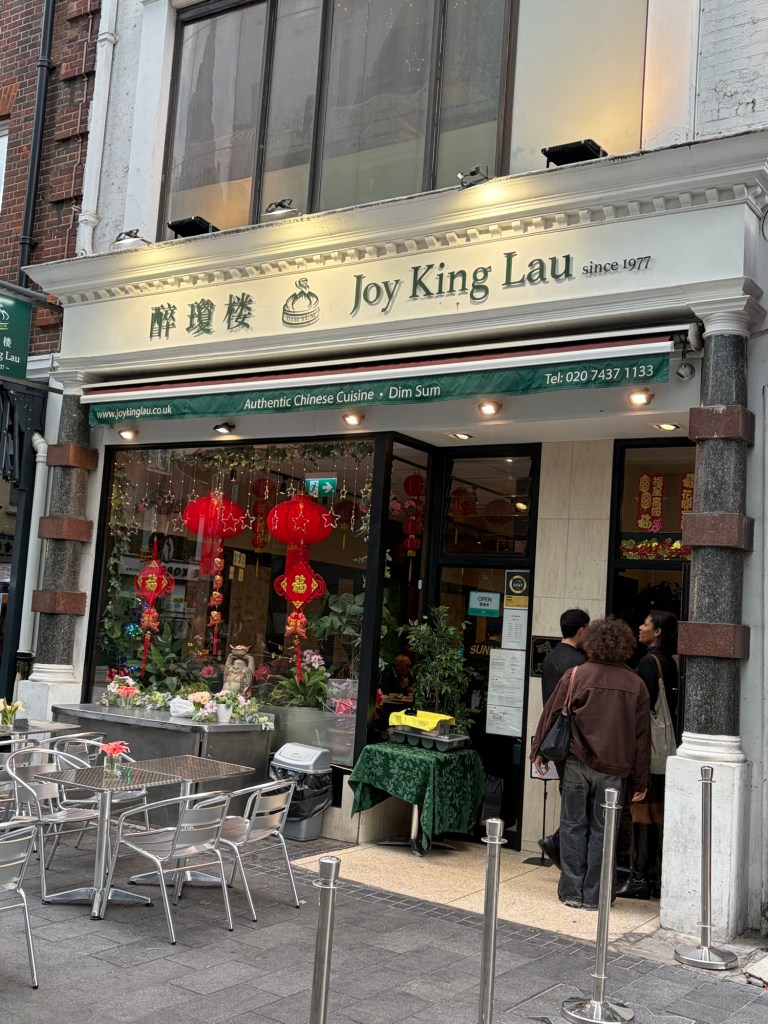
Then Chinatown and a reservation at Joy King Lau, where a large and excellent meal awaited.
Somewhere between the dumplings, I was teleported back to Shanghai. My handful of Chinese words came flooding back, and I must have pronounced them rather well, because the head waitress responded with a torrent of fluent Mandarin. I understood none of it. My strategy: friendly grunts and a warm smile. Diplomacy, it turns out, is 80% nodding.
Sadly, my left foot then declared independence for reasons unknown. Walking was off the agenda. We still limped to Piccadilly Circus for a little shopping (priorities), then rode the tube back to Southwark.
I’m now writing with my foot elevated and a strong painkiller doing its best. The treatment plan is clinical: a visit to the local pub, where pints of real ale will perform the healing, followed by a couple of large nightcaps “for good measure.”
Doctors may disagree. The pub, I’m confident, will not.
3:30 a.m. My body, apparently still on a schedule known only to itself, woke me for the third morning running. I then lay there for nearly two hours, staring at the ceiling and composing strongly worded letters to my circadian rhythm. Eventually sleep returned, like a guest who shows up after the party has ended.
Coffee in bed followed, brewed this time with bottled water bought the night before. Lesson learned: London’s tap water is a crime scene, and the bottled stuff is the only witness willing to cooperate. A drinkable cup at last. Small victories.
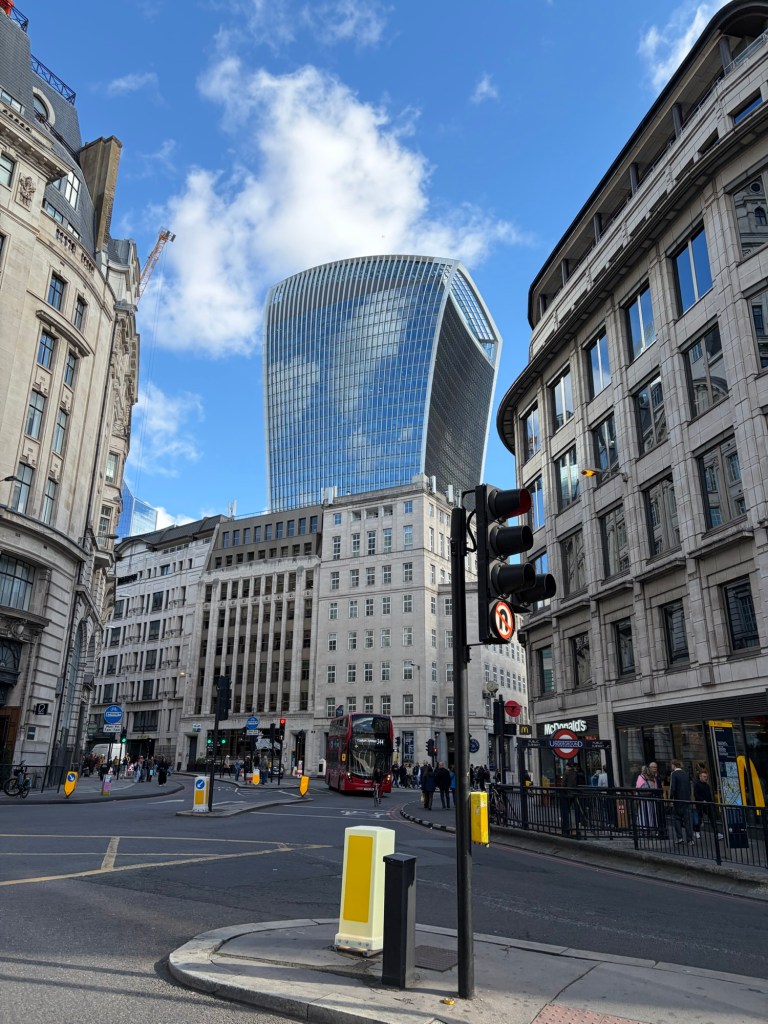
By 9 a.m. we were out the door, ready for a brisk march to Petticoat Lane Sunday market via the Millennium Bridge, St Paul’s Cathedral, and the Gherkin, which I still refuse to look at without feeling mildly judged. On arrival, one is immediately reminded of Del Boy Trotter, even though Peckham is nowhere near. Lovely jubbly, as they say, but I stayed vigilant for anything that “fell off the back of a lorry.”
Refuelling took place in a tiny Swedish cafeteria, where I ordered coffee and a sausage roll that turned out to be plant-based. A sausage roll with no sausage. A bold choice, and frankly, a plot twist I didn’t see coming. It was tasty, though I remain suspicious.
Then it was off toward Covent Garden, lunch being a non-negotiable deadline. Once we rediscovered St Paul’s (it’s hard to lose, but we managed to make it feel like an achievement), Fleet Street led us neatly into the Strand. We stopped one block short of Covent Garden at Bella Italia. I suddenly fancied pasta, which is the kind of sudden fancy that should always be obeyed. I ordered it, I ate it, I was happy. Next.
From our table we could see the Lyceum Theatre 🎭, where we held tickets for the 2:30 p.m. matinee of The Lion King. Knowing we’d be pinned to our seats for a good 2.5 hours, we took a quick stroll through Covent Garden first. Think of it as pre-emptive stretching for the sedentary marathon ahead.
The verdict on The Lion King? Excellent. The costumes, the scenery, the cast, the music, the songs: all of it thoroughly entertaining. Even from the stalls, the circle of life felt very much in session.
Afterwards we walked back to the hotel to put our feet up and deliberate over the evening’s agenda. Which brings me to the present, where I sit writing these lines and surveying the pub options within a 300-metre radius. Rigorous research, you understand. Choosing wisely is a serious business.
Today’s tally: 9.6 km on foot, one plant-based sausage roll, one plate of pasta, one lion king, and zero hours of decent sleep. Not bad, London. Not bad at all.
Cheers, and see you at Day 4, probably awake at 3:30 again. 🍺
Breakfast: croissant 🥐 and tea in bed, which is where the day’s first Big Decision was made. “Why don’t we walk to Marble Arch instead of taking the tube?” Reader, this was said by a person who had not yet met the day’s mileage. It was cool, dry, sunny, and only 4.7km. Only. The most dangerous word in travel.
Off we trot at 9am, across the bridge, past Trafalgar Square, Piccadilly Circus and Regent Street, where devoted citizens queued for shops to open at 10, like pilgrims awaiting a sale on holy ground. Oxford Street was its usual calm, spacious self (it was not). We arrived at Marble Arch, parked ourselves in a coffee shop, and waited for my sister-in-law. Then came Frameless, my second visit in three months. Verdict: still worth it, even without the element of surprise. Art that survives repeat viewing is the only kind I trust. Same goes for sisters-in-law.
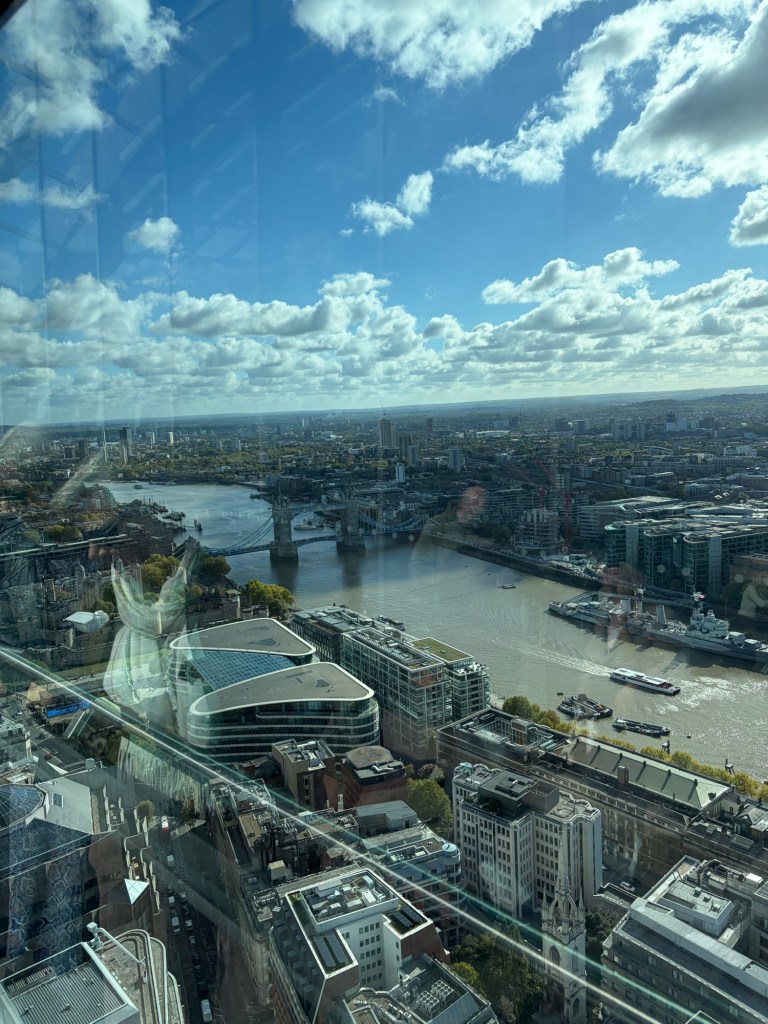
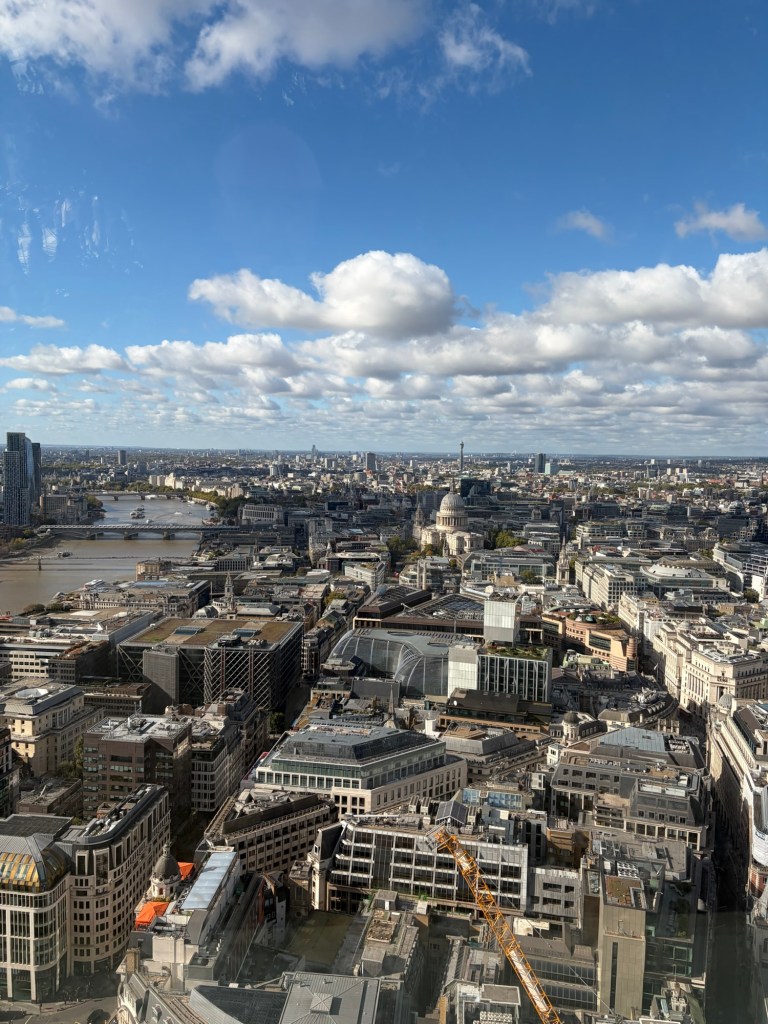
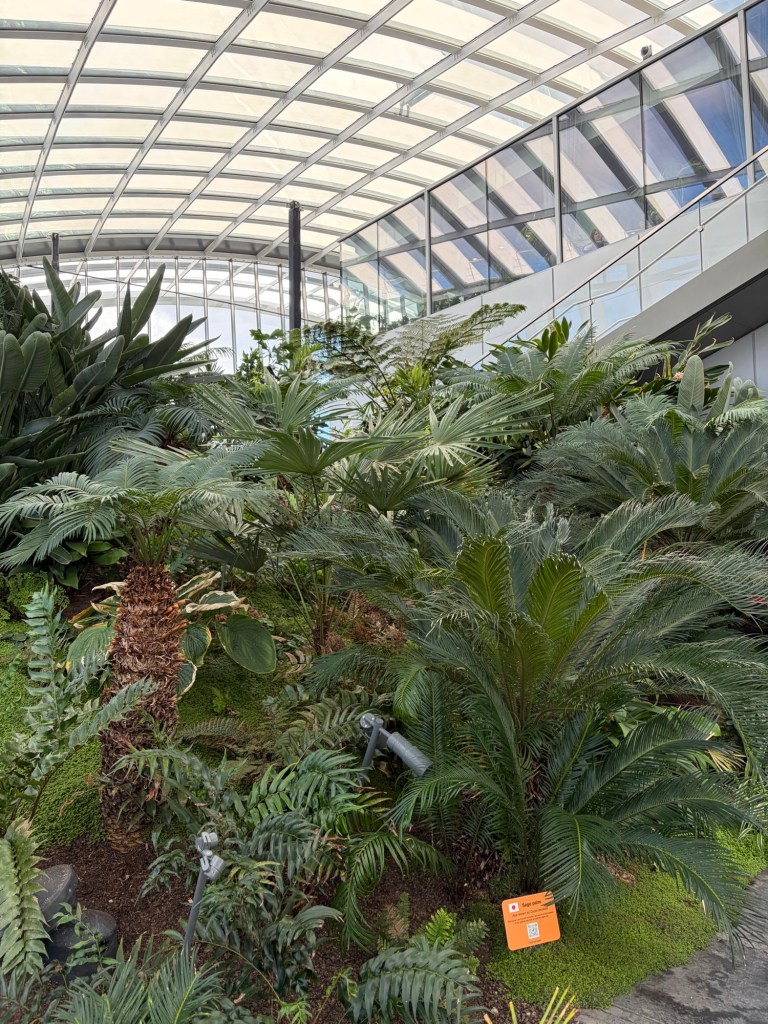
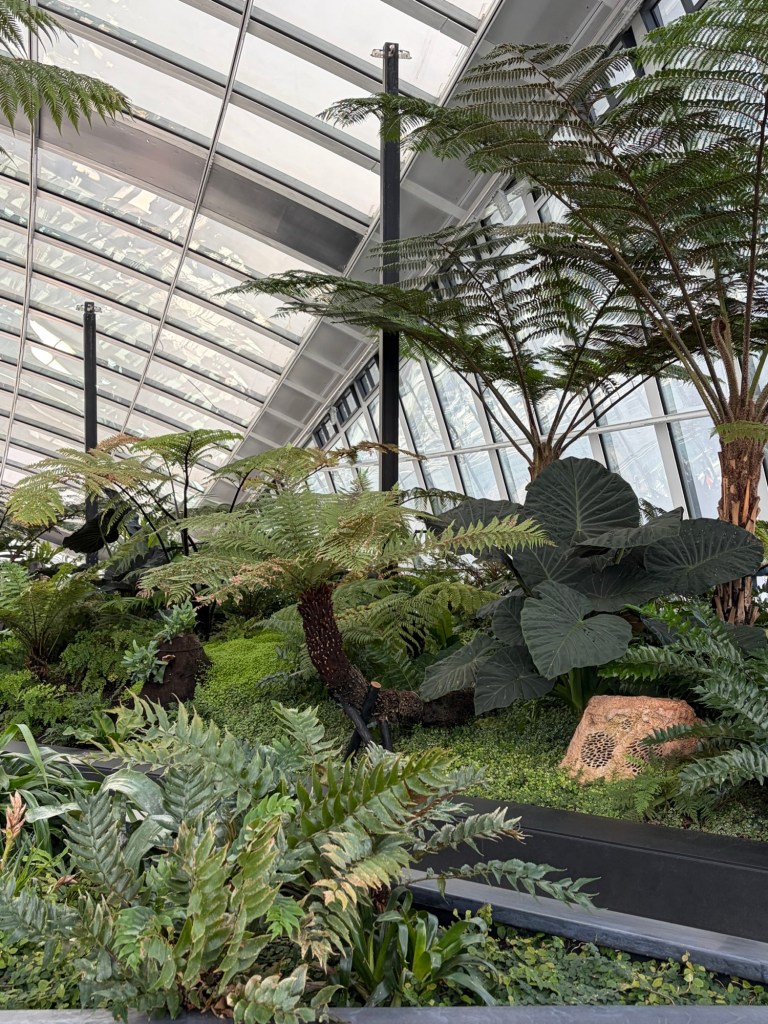
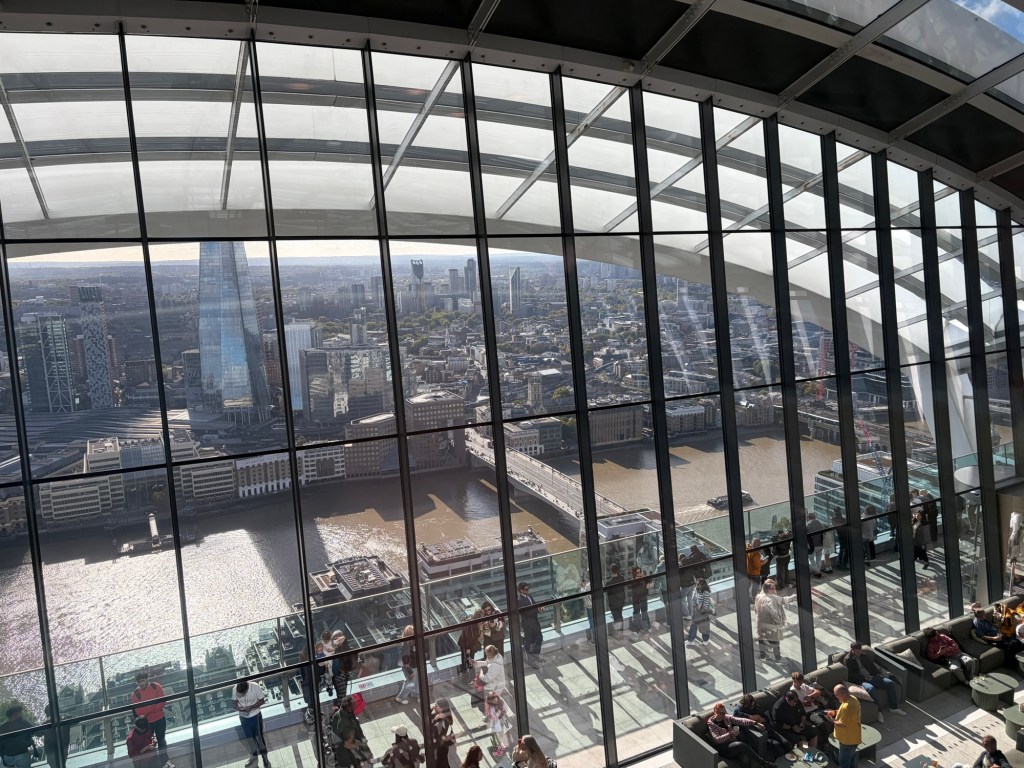
Then the Tube to Sky Garden, with a noble plan for a pre-lunch pint. London, however, had other ideas: not a single available pub. A city with 3,500 pubs and we couldn’t find one. So we went straight up to the 35th floor and drank with a view instead, which is the sort of problem I’m happy to have. Lunch at the Darwin Brasserie, window table, naturally (I had reserved it, thank you). Good food, took our time, very busy. A triumph.
Of course, a big lunch demands a digestive drink. That’s medicine. Across the river to the South Bank for Peaky Blinders. We got in! Success! No seats, and noise at a volume usually reserved for aircraft carriers. By order of the Shelby family, we left.
Onward through Borough Market to the Bunch of Grapes, a Young’s pub where I knew from experience a decent pint of Special awaited. And it did. Experience pays. Then we parted ways: my sister-in-law boarded a train home to her south-east coastal town, and we promised to reunite in Paris in the New Year. (Poland was apparently also discussed. Plans were made. Ask me again in January.)
We walked back to the hotel for a one-hour rest, which is just a nap that has been given a job title. Then to Waterloo and the tube to Charing Cross. Covent Garden station is dead to me: the gigantic lift queue and the 299 steps, a stair-based hostage situation my knees refuse to negotiate.
The plan was a drink at the Coal Hole on the Strand, but, like every other pub in London today, it was far too busy. Are the Londoners all in pubs? Is nobody working? Swift pivot to the terrace bar at the top of the Royal Opera House for an eye-wateringly expensive gin and tonic. Pricey, yes, but the view was lovely and the ice was probably imported.
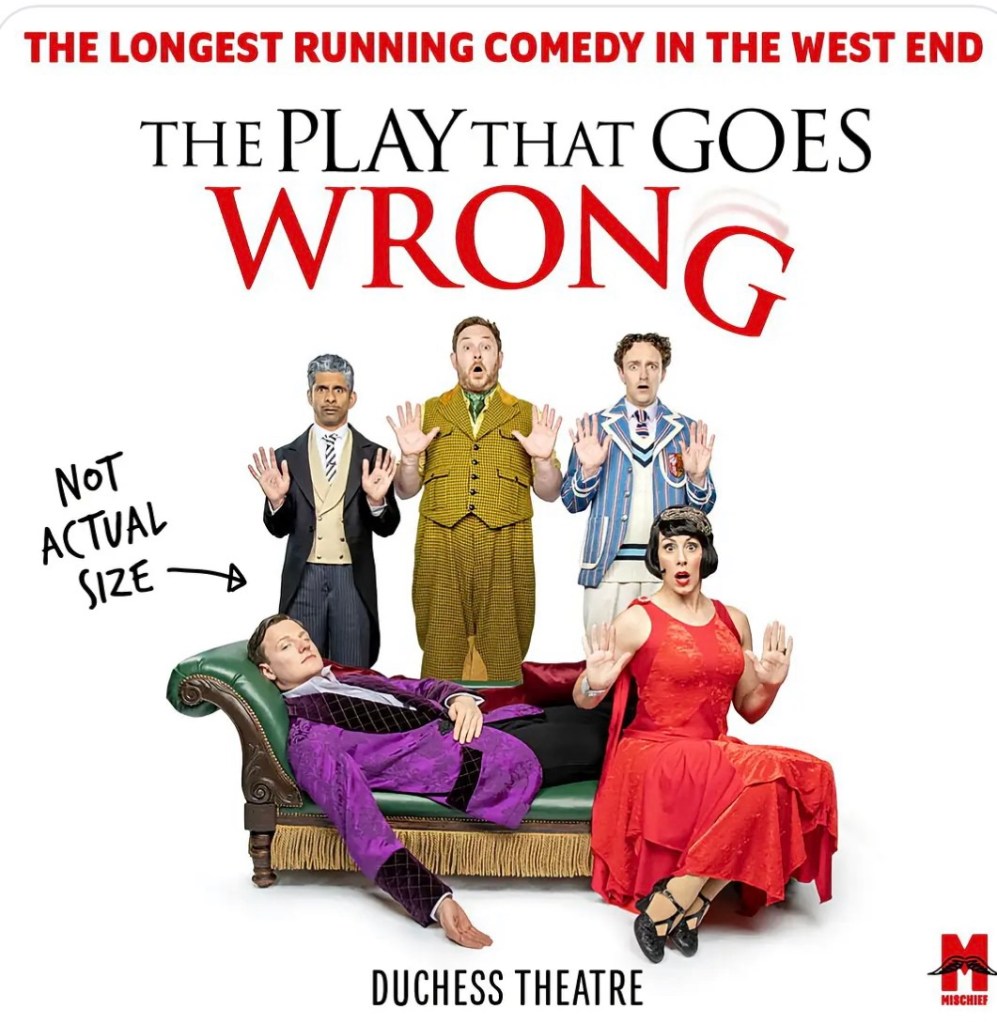
Then the Duchess Theatre, 3 minutes away, with time to spare. The Play That Goes Wrong was very funny with excellent set design, which is the only time I’ll applaud things falling apart on purpose. 🎭
Nightcap at the Wellington around the corner (a Guinness, because I’m a creature of habit), then a stroll back to the hotel across the river.
Early to bed after 13.4km on foot. Tomorrow’s decision: absolutely no more “only 4.7km” walks. (Tomorrow we will absolutely do one.) 😴
Or: how my meticulously timed itinerary lasted roughly 2 hours
I arrived in London with a plan. A proper plan. Timed, scheduled, practically laminated. Napoleon would have looked at it and said, “A bit much, mate.”
Then reality turned up, wearing a Ryanair lanyard.
The journey (a cautionary tale)
The flight to Stansted was, and I choose my words carefully here, horribly uncomfortable. I’ve had more legroom in a hamster ball. Once safely on the ground, I was rewarded with an hour on the Stansted Express and a couple of tube changes, which is London’s way of asking, “Are you sure you wanted to come?”
Yes. Yes, I was.
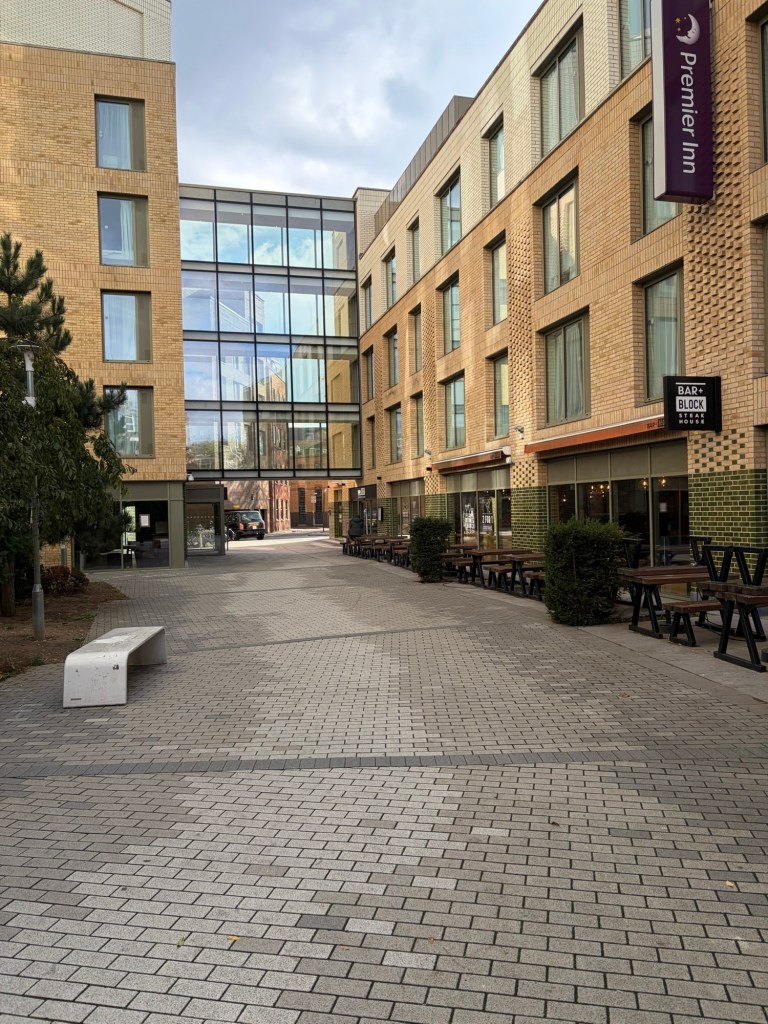
Eventually we reached Southwark station and our Premier Inn. The room is fine, the location is excellent, and nobody has yet attempted to charge me for breathing, so we’re off to a strong start.
Step one: the schedule says pub
Bags dropped, and exactly on schedule (enjoy that, it’s the last time), we marched to the marvellous old Lord Clyde for a pint of Tribute. Real ale, properly kept, in a proper pub. Each sip washed away another layer of Ryanair trauma. By the bottom of the glass, I had been fully rehabilitated and was prepared to forgive everyone, including the airline. (I later reconsidered.)
Step two: the schedule is overruled by my stomach
Unfortunately, real ale has a side effect: it makes you hungry. And so, with no warning to the Ministry of Itineraries, we deviated from the plan and headed to Est. India, the local Indian restaurant. The gin and tonic was good. The food was excellent. The plan was quietly taken outside and shot.
I suspect this will not be my only curry of the trip. The itinerary may as well accept this now and save us both the heartache.
Step three: early night (a bold strategy)
A ten-minute stroll brought us back to the hotel for an early night, UK time. A sensible, mature decision, made by a man who clearly doesn’t know his own body.
Because here I am at 3:30am, wide awake, typing this on my phone with the thumbs of a man wearing oven gloves. Jet lag is a stretch for a one-hour time difference, so I’m calling it what it is: Premier Inn’s very comfortable beds conspiring with a curry-and-ale cocktail to keep me up.
Day 2 awaits. The plan says “sightseeing.” My stomach says “breakfast.” We all know who’s winning.
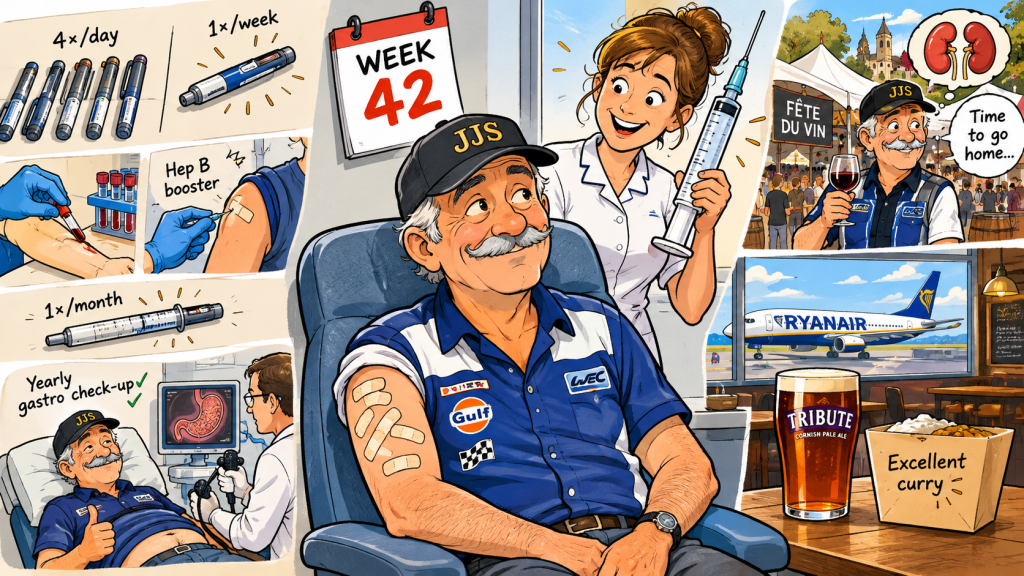
Week 42, in which I become a human pincushion and then fly Ryanair
If this past week had a theme song, it would be a very small, very sharp ping. Needles. So many needles.
Let’s start with the baseline: four insulin shots a day, plus the weekly GLP-1 jab. That’s the everyday maintenance package. But this week, the hospital decided I wasn’t pierced enough and added a blood test, followed by a Hepatitis B booster. Then, on Thursday, came the monthly main event: a needle so enormous that the nurses gather round to admire it like it’s a prize marrow at the village show. Luckily, I have the right bum for the job. Every man should know his strengths.
With this many holes in me, I’m honestly surprised I’m not leaking when I walk. What’s left in there must be a truly remarkable cocktail, which probably explains why I’m no longer allowed to donate blood. I’d like to think the Blood Service looked at my file and simply said, “No, that’s a bit much, even for us.”
The quiet bits
Apart from the pincushion routine, it was a gentle start to the week. The days are getting cooler and I’m slowly adjusting. Plans are brewing: a night out in Nîmes before the month is over, and a pile of reservations made ahead of the London trip.
It’s also medical season, so midweek brought my yearly check-up with my new gastroenterologist. Verdict: nothing to report. In medical terms, that’s the best review you can get. Five stars, would be ignored again.
Fête du vin: a tale of unrealised enjoyment
Thursday was a lazy affair until evening, when the annual Fête du vin kicked off, with a few more stands than last year. We made it in time for the opening speeches, which were dreadful. I’ll say no more, other than that the wine could only improve things.
Friends arrived, ten of us gathered, and we enjoyed a few glasses. And by “enjoyed,” I may be exaggerating slightly. The truth is I’ve never been keen on drinking wine outside of a meal, and it’s getting worse with age. My kidneys filed a formal complaint and I went home early. A tragic loss for the festival, I’m sure.
Ryanair, or: Why I Suffer
Friday was all about setting the house in order, packing, and making our way to the local airport for the flight to London. I swear, hand on heart, I will never fly Ryanair again. (Obvious exception: getting home in a few days. I’m not made of money, or of patience.)
But then came redemption. A pint of Tribute real ale at the old Lord Clyde in Southwark, a few minutes from the hotel, followed by an excellent curry at Est India just two minutes further on. By the end of the second course, the journey was a distant memory and I was a man at peace.
London adventures to follow in a separate post. Stay tuned, and stay hydrated. Preferably not with wine.
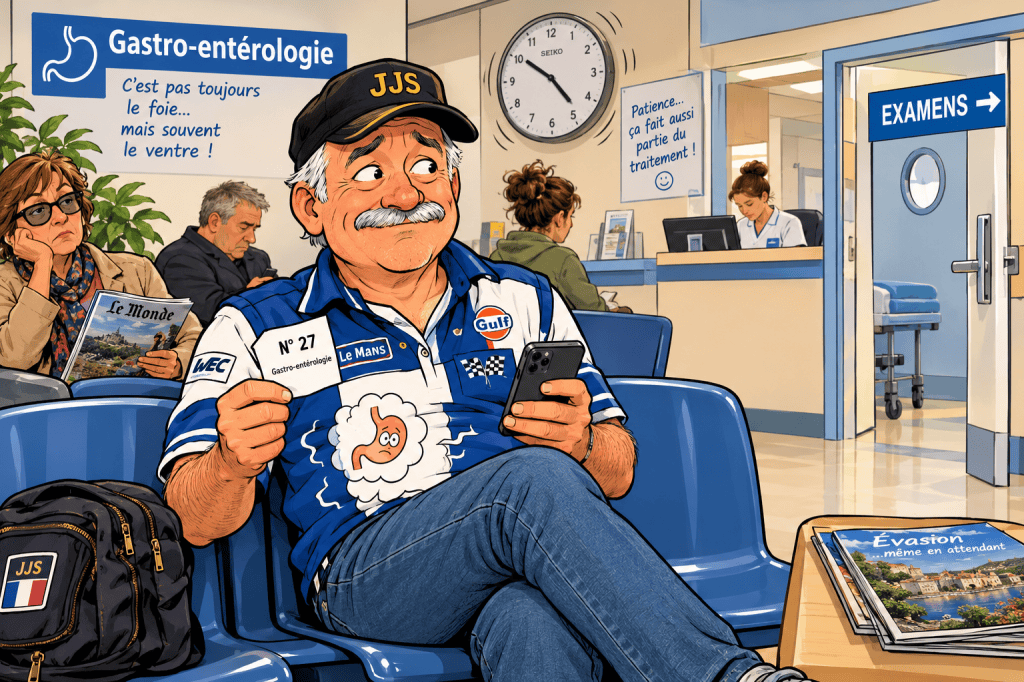
I am writing to you live from the hospital waiting room, that sacred place where time stands still, magazines date from the previous administration, and everyone studies their own shoes with intense interest.
Today I am seeing a new gastroenterologist. My beloved previous one, a charming Luxembourger with whom I could chat in German, has been promoted to head of the service and no longer sees outpatients. I like to think he is now in a corner office somewhere, wearing a very important lanyard, managing the team and surgically removing things from people who are not me. We had something special, he and I. Now I have been passed on, like a hand-me-down jumper.
The hospital itself feels different: busier, buzzier, and I suspect some of the layout has been quietly improved. Naturally I noticed this only because I was trying to work out how to escape. A hospital is still a hospital, and I am about as comfortable here as a cat at a bath party.
And then came the shock. I was seen on time. In France! I had to check my watch, then the calendar, then my pulse. Having lived through the German experience, where punctuality is a national religion that mysteriously stops at the hospital door, I am forever amazed that France, the land of the leisurely lunch, delivers on the dot. Somewhere, a Prussian clerk is weeping into his appointment book.
Further follow-ups have been planned, so this is clearly the start of a beautiful, long-term relationship. I also left with the prescription I came for, which in hospital terms counts as winning the lottery.
Meanwhile, my left kidney, or rather the stone residing in it, chose this moment to start grumbling. I can only assume it knows exactly where it is. “Ah, a hospital! Lots of staff, lots of trolleys, excellent emergency facilities. Now would be a splendid time to make a scene.” Dramatic little pebble. It has all the subtlety of a toddler who senses a supermarket checkout nearby.
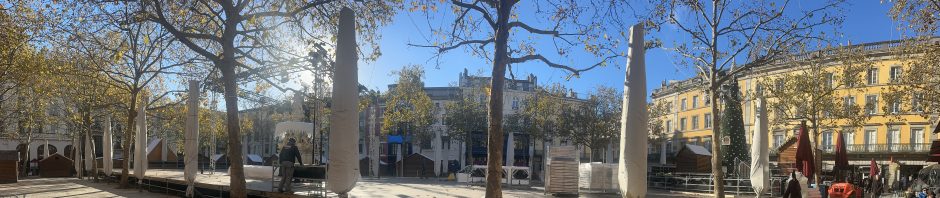
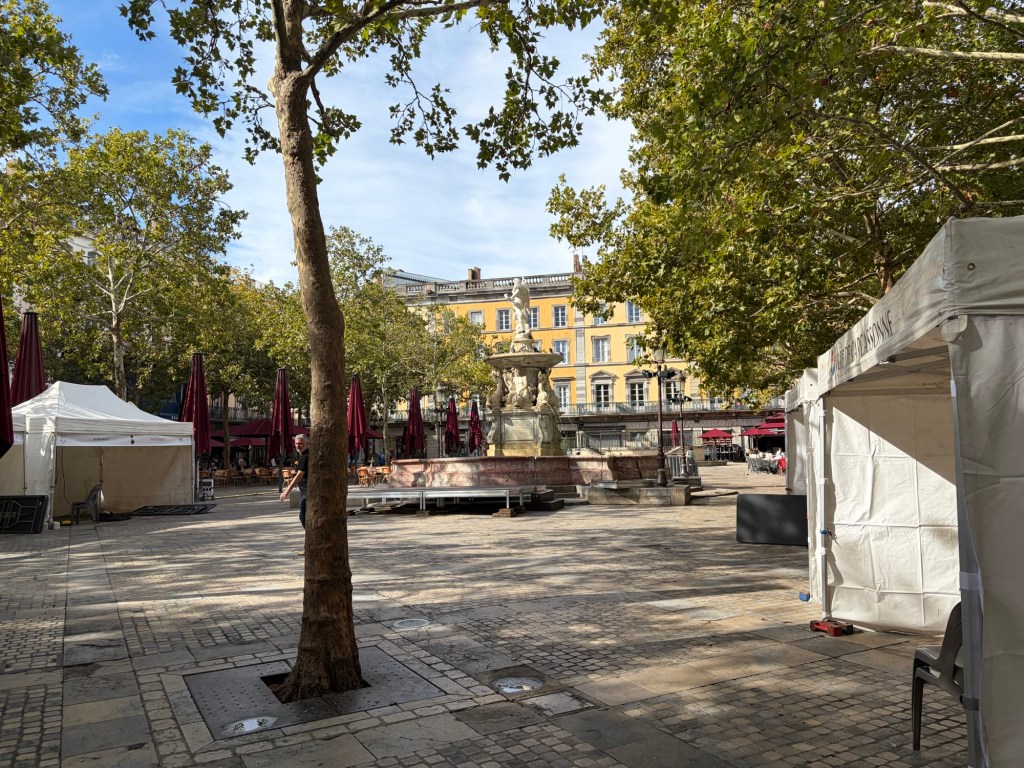
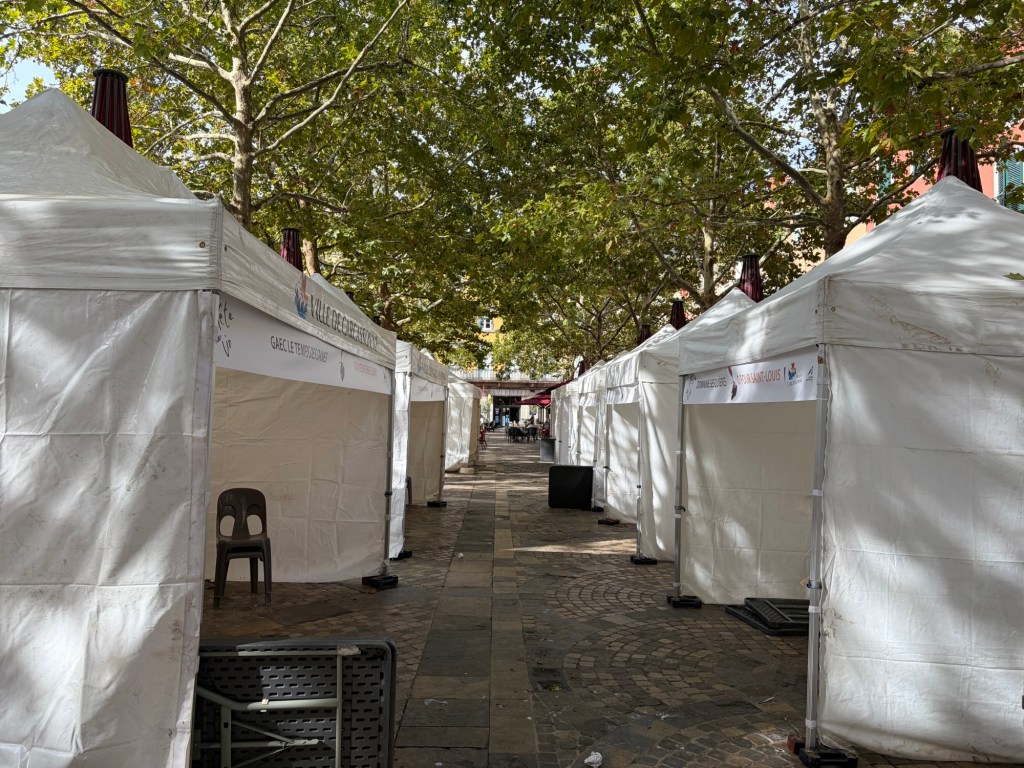
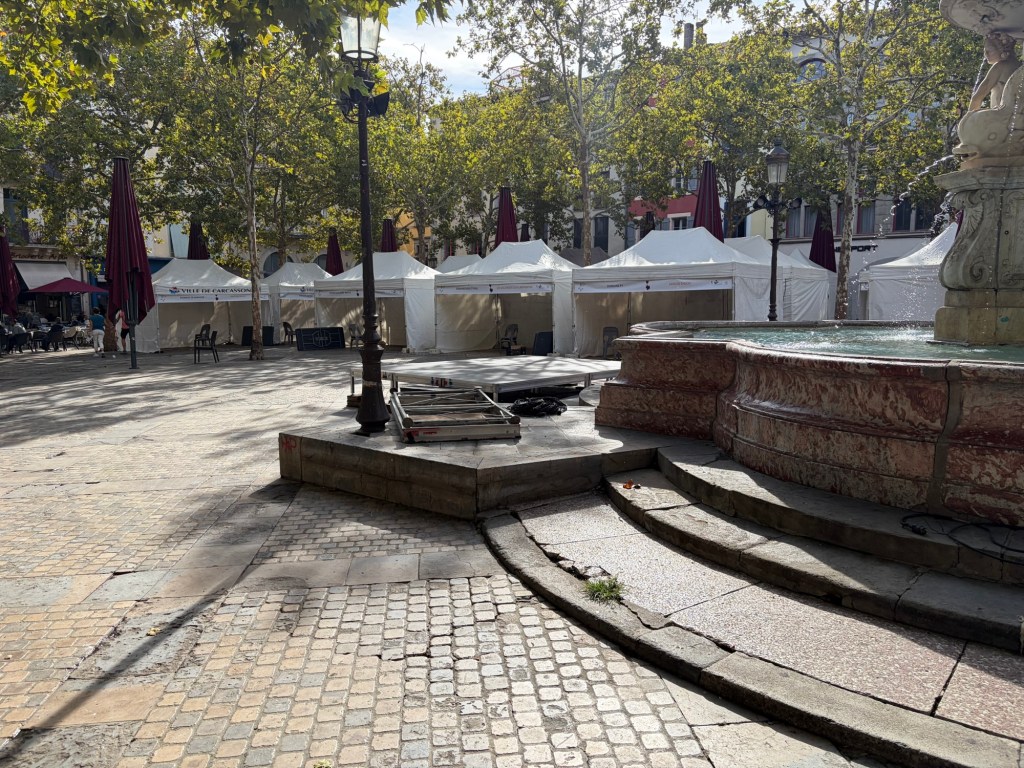
Back in town, I popped into the chemist for my injection, because nothing says “I’m having a glamorous day” like a jab and a paper bag. And then, wonder of wonders: the tents are up on Place Carnot for the annual wine festival, which starts tomorrow!
Now, I am in the middle of a long period of abstinence. Not a weekend detox, not a Dry January with a sulk, but a proper, extended, character-building stretch. Purely a health measure, you understand. But looking at those tents, I feel my resolve wobbling like a jelly on a washing machine. I may well end my dry spell a day early, which, given its length, is a bit like leaving a marathon at kilometre 41. For the sake of the local economy, naturally.
In fact, to steady the nerves after a day of hospital corridors, belligerent kidney stones and punctual doctors, I may indulge in a couple of large Scotch whiskies tonight. Medicinal, obviously. After such a long drought, I suspect the first one will be less a drink and more a reunion, complete with tears and a slow-motion run across a field.
Tomorrow, the wine festival. Tonight, the whisky. And somewhere in my left flank, a small stone waits patiently, plotting its next move.
Cheers, everyone. Or as they say in Luxembourg: Prost!
🇫🇷
Chroniques de salle d’attente : une aventure gastro
Je vous écris en direct de la salle d’attente de l’hôpital, ce lieu sacré où le temps s’arrête, où les magazines datent du gouvernement précédent et où chacun étudie ses chaussures avec un intérêt soutenu.
Aujourd’hui, je vois un nouveau gastro-entérologue. Mon ancien médecin, un charmant Luxembourgeois avec qui je pouvais bavarder en allemand, a été promu chef de service et ne reçoit donc plus de patients en consultation externe. J’aime à l’imaginer dans un bureau d’angle, affublé d’un badge très important, dirigeant son équipe et retirant chirurgicalement des organes à des gens qui ne sont pas moi. Nous avions quelque chose de spécial, lui et moi. Me voilà refilé à un autre, comme un pull de seconde main.
L’hôpital lui-même a changé d’ambiance : plus animé, plus bourdonnant, et je soupçonne que l’agencement a été discrètement amélioré. Évidemment, je ne l’ai remarqué qu’en cherchant la sortie. Un hôpital reste un hôpital, et je m’y sens aussi à l’aise qu’un chat à une fête de la baignoire.
Et puis, le choc. J’ai été reçu à l’heure. En France ! J’ai dû vérifier ma montre, puis le calendrier, puis mon pouls. Après mon expérience allemande, où la ponctualité est une religion nationale qui s’arrête mystérieusement à la porte de l’hôpital, je ne cesse de m’étonner que la France, pays du déjeuner qui s’éternise, tienne ses horaires à la minute. Quelque part, un greffier prussien pleure dans son agenda.
Des rendez-vous de suivi sont déjà prévus : c’est donc clairement le début d’une belle et longue histoire. Je repars aussi avec l’ordonnance que j’étais venu chercher, ce qui, en milieu hospitalier, équivaut à gagner au loto.
Pendant ce temps, mon rein gauche, ou plutôt le calcul qui y a élu domicile, a choisi ce moment pour se manifester. Je ne peux que supposer qu’il sait très bien où il se trouve. « Ah, un hôpital ! Plein de personnel, plein de brancards, d’excellentes urgences. Voilà le moment idéal pour faire un scandale. » Petit caillou dramatique. Il a la subtilité d’un enfant de trois ans qui sent la caisse du supermarché approcher.
De retour en ville, je suis passé à la pharmacie pour ma piqûre, car rien ne dit « quelle journée glamour » comme une injection et un sachet en papier. Et là, ô merveille : les tentes sont montées place Carnot pour la fête annuelle du vin, qui commence demain !
Or, je suis actuellement en pleine période d’abstinence. Longue. Pas une cure de désintoxication de week-end, pas un Janvier sec avec la mine boudeuse, mais une vraie période prolongée qui forge le caractère. Purement une mesure de santé, vous comprenez. Mais devant ces tentes, ma résolution se met à trembloter comme une gelée sur une machine à laver. Je pourrais bien mettre fin à ma disette un jour plus tôt, ce qui, vu sa durée, revient à abandonner un marathon au kilomètre 41. Pour le bien de l’économie locale, naturellement.
D’ailleurs, pour calmer mes nerfs après une journée de couloirs d’hôpital, de calculs rénaux belliqueux et de médecins ponctuels, je m’offrirai peut-être un ou deux grands verres de whisky ce soir. À titre médicinal, bien sûr. Après une si longue sécheresse, je soupçonne que le premier ne sera pas tant une boisson qu’des retrouvailles, avec larmes et course au ralenti à travers un champ.
Demain, la fête du vin. Ce soir, le whisky. Et quelque part dans mon flanc gauche, un petit calcul attend patiemment, préparant son prochain coup.
Santé à tous ! Ou, comme on dit au Luxembourg : Proscht !
🇩🇪
Wartezimmer-Chroniken: Ein Gastro-Abenteuer
Ich schreibe Ihnen live aus dem Wartezimmer des Krankenhauses, diesem heiligen Ort, an dem die Zeit stillsteht, die Zeitschriften noch aus der vorletzten Regierung stammen und jeder mit größtem Interesse seine eigenen Schuhe studiert.
Heute sehe ich einen neuen Gastroenterologen. Mein geschätzter bisheriger Arzt, ein charmanter Luxemburger, mit dem ich mich auf Deutsch unterhalten konnte, ist zum Leiter der Abteilung befördert worden und behandelt keine ambulanten Patienten mehr. Ich stelle ihn mir gern in einem Eckbüro vor, mit einem sehr wichtigen Namensschild um den Hals, wie er sein Team leitet und Menschen, die nicht ich sind, fachmännisch Dinge entfernt. Wir hatten etwas Besonderes, er und ich. Jetzt wurde ich weitergereicht wie ein abgetragener Pullover.
Das Krankenhaus selbst wirkt anders: geschäftiger, summender, und ich vermute, dass die Raumaufteilung still und leise verbessert wurde. Aufgefallen ist mir das natürlich nur, weil ich nach dem Ausgang gesucht habe. Ein Krankenhaus bleibt ein Krankenhaus, und ich fühle mich hier ungefähr so wohl wie eine Katze auf einer Badewannenparty.
Und dann der Schock: Ich wurde pünktlich aufgerufen. In Frankreich! Ich musste erst auf die Uhr schauen, dann auf den Kalender, dann den Puls fühlen. Nach meinen Erfahrungen in Deutschland, wo Pünktlichkeit eine Nationalreligion ist, die rätselhafterweise an der Krankenhaustür endet, staune ich immer wieder, dass ausgerechnet Frankreich, das Land des ausgedehnten Mittagessens, auf die Minute liefert. Irgendwo weint ein preußischer Beamter in seinen Terminkalender.
Weitere Kontrolltermine sind bereits geplant, das ist also eindeutig der Beginn einer wunderbaren, langen Beziehung. Außerdem habe ich das Rezept bekommen, wegen dem ich gekommen war, was in Krankenhauskategorien einem Lottogewinn gleichkommt.
Währenddessen hat sich meine linke Niere, genauer gesagt der Stein darin, entschieden, genau jetzt zu murren. Ich kann nur annehmen, dass er genau weiß, wo er sich befindet. „Ah, ein Krankenhaus! Viel Personal, viele Rollbetten, hervorragende Notaufnahme. Der ideale Moment für einen Auftritt.” Dramatisches kleines Steinchen. Es hat das Feingefühl eines Dreijährigen, der die Supermarktkasse wittert.
Zurück in der Stadt, schaute ich in der Apotheke für meine Spritze vorbei, denn nichts sagt „Was für ein glamouröser Tag” so sehr wie eine Injektion und eine Papiertüte. Und dann, o Wunder: Auf der Place Carnot stehen schon alle Zelte für das jährliche Weinfest, das morgen beginnt!
Nun befinde ich mich derzeit in einer Abstinenzphase. Einer langen. Keine Wochenend-Entgiftung, kein „Dry January” mit beleidigtem Gesicht, sondern eine richtige, ausgedehnte, charakterbildende Durststrecke. Rein aus gesundheitlichen Gründen, versteht sich. Doch beim Anblick dieser Zelte gerät meine Entschlossenheit ins Wanken wie ein Wackelpudding auf der Waschmaschine. Gut möglich, dass ich meine Trockenzeit einen Tag früher beende, was bei ihrer Länge ungefähr so ist, als würde man den Marathon bei Kilometer 41 abbrechen. Zum Wohle der lokalen Wirtschaft, selbstverständlich.
Um die Nerven nach einem Tag voller Krankenhausflure, streitlustiger Nierensteine und pünktlicher Ärzte zu beruhigen, gönne ich mir heute Abend vielleicht ein, zwei große Scotch. Medizinisch, versteht sich. Nach so langer Dürre vermute ich, dass der erste weniger ein Getränk als ein Wiedersehen sein wird, mit Tränen und einem Lauf in Zeitlupe über eine Wiese.
Morgen das Weinfest. Heute Abend der Whisky. Und irgendwo in meiner linken Flanke wartet geduldig ein kleiner Stein und schmiedet seinen nächsten Plan.
Prost allerseits! Oder, wie man in Luxemburg sagt: Proscht!