🇫🇷
Les tribulations d’un mari provisoirement abandonné
Il faut savoir que lorsqu’une épouse s’envole pour l’Allemagne — fût-ce pour des raisons aussi nobles que la garde d’un petit-enfant — elle laisse derrière elle un vide que rien, pas même le mistral, ne saurait combler tout à fait.
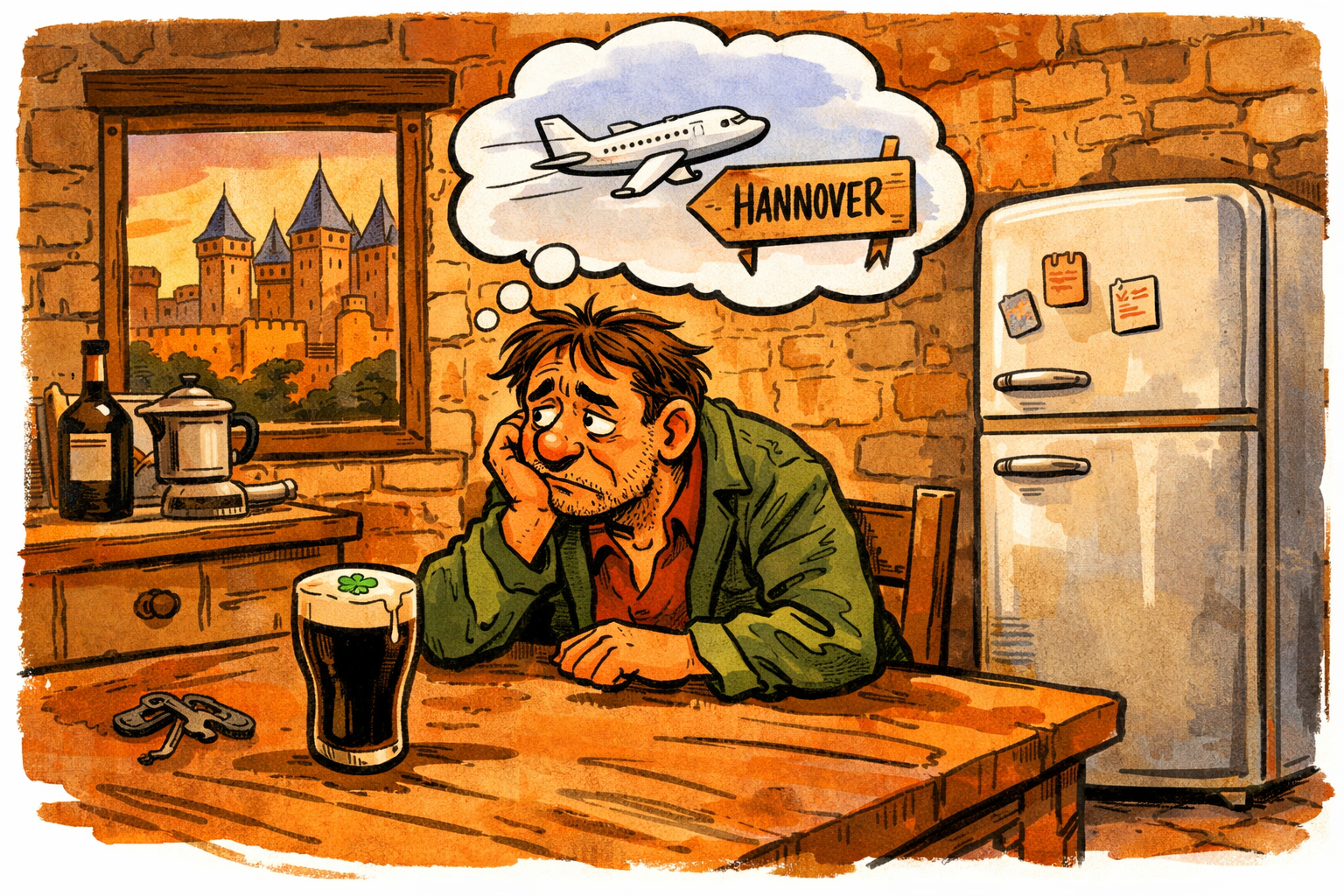
Ma femme est partie pour Hanovre. Hanovre. Une ville qui existe, paraît-il, et qui s’en satisfait fort bien. Elle y est allée avec un entrain que je qualifierai de remarquable, voire de légèrement suspect, pour veiller sur l’un de nos petits-enfants. Moi, je suis resté à Carcassonne. Seul. Avec les pierres, le ciel, et le sentiment vague d’être un homme à qui l’on aurait subitement retiré le mode d’emploi de sa propre maison.
Les Allemands ont un mot pour ça, naturellement. Ils ont un mot pour tout — c’est leur manière à eux de faire de la philosophie sans s’asseoir à la terrasse d’un café. Ils appellent ça Strohwitwer : le veuf de paille. Celui dont la femme n’est pas morte, non, simplement ailleurs, ce qui dans la pratique quotidienne revient à peu près au même. César, dans ces circonstances, aurait commandé une anisette. Marius aurait regardé la mer. Moi, j’ai regardé le réfrigérateur.
Le réfrigérateur, il faut le dire, ne m’a pas répondu.
C’est dans ces moments-là qu’on mesure ce que représente une femme dans une maison. Non pas qu’elle fasse tout — attention, je ne dis pas ça — mais elle fait un certain nombre de choses essentielles que l’on ne remarque que lorsqu’elles ne sont plus faites. Il y a dans ce constat une profonde vérité humaine que Pagnol aurait développée sur deux actes et que je résumerai ainsi : je n’ai pas retrouvé le tire-bouchon.
Or, c’est aujourd’hui la Saint-Patrick. Et la Saint-Patrick ☘️, comme la tramontane ou l’addition au restaurant, ne prévient pas et ne s’excuse pas. Il y a dans cette ville un pub irlandais. Il y a dans ce pub irlandais de la Guinness. Et il y a en moi, quelque part entre le sternum et la conscience, quelque chose qui ressemble à un devoir civique.
L’Irlande et la Provence, au fond, se comprennent. Deux pays où l’on parle beaucoup, où l’on boit sérieusement, et où un homme seul au comptoir n’est pas un homme qui a échoué mais un homme qui réfléchit. Saint Patrick a chassé les serpents d’Irlande. Ma femme, elle, est partie pour Hanovre. Les résultats sont comparables.
Je lèverai donc mon verre ce soir — un pour l’Irlande, un pour l’Allemagne qui m’a fourni le vocabulaire de ma condition, et un, le plus important, pour elle qui est là-bas à bercer notre petit-enfant pendant que je cherche le tire-bouchon.
Sláinte. Prost. Et à ta santé, mon amour — le réfrigérateur te fait dire bonjour.
🇬🇧
There is a particular kind of solitude that descends upon a man when his wife disappears to Germany on grandparental duty. It is not loneliness, exactly. It is more like the eerie silence of a battlefield after everyone has gone home, leaving you standing there holding a spatula and wondering what you’re supposed to do with it.
My wife has flown to Hannover — a city which, to its eternal credit, exists, and which is twinned with several other cities presumably out of a deep civic need to share the experience — to perform heroic acts of babysitting for one of our grandchildren. She went willingly. She was, if anything, suspiciously cheerful about leaving. Meanwhile I have been left behind in Carcassonne, rattling around the house in a state the Germans describe with devastating precision as Strohwitwer: a straw widower. A man whose wife is not dead, just elsewhere, and who nonetheless wanders the kitchen at odd hours achieving nothing in particular.
The Germans, of course, have a word for everything. They have a word for the pleasure derived from other people’s misfortune (Schadenfreude), a word for the melancholy of things not lasting (Vergänglichkeit), and presumably a word for the specific feeling of standing in front of an open fridge at 11pm knowing full well that nothing in it has changed since you last checked three minutes ago. They call this kind of linguistic precision efficiency. The rest of us call it unsettling.
It should be noted that German humour is, on good authority, no laughing matter. This has not stopped me from finding the whole situation faintly comic — the abandoned husband, the faraway wife, the grandchild who will remember none of this, and Hannover, stoically getting on with being Hannover.
Now, under normal circumstances I might have spent this bachelor interlude in quiet, dignified contemplation. Reading. Listening to music. Performing small acts of domestic virtue to impress no one. Very ordentlich, as they say. Very tidy. Very correct. The Germans would approve, briefly, before suggesting improvements.
But it is, as fate would have it, Saint Patrick’s Day ☘️. And Saint Patrick’s Day, much like an old friend who shows up uninvited, does not really take no for an answer. It is, in this sense, the opposite of a German bureaucratic process, which takes every answer as a reason to request additional documentation.
There is an Irish pub. There is Guinness. And there is, somewhere deep in my chest, the faint stirring of a man who has remembered that Ireland once gave the world both Samuel Beckett and a convincing excuse to drink stout on a Tuesday afternoon. Two nations, Ireland and Germany, united tonight in my personal itinerary: one providing the occasion, the other the vocabulary to describe my domestic condition with clinical accuracy.
My wife will be busy with the grandchild. The grandchild will be blissfully unaware of geopolitics. And I will be at the bar, raising a glass to Saint Patrick, to Hannover, to whoever invented the concept of the straw widower, and to the quietly magnificent truth that sometimes being left behind has its compensations.
Sláinte. Prost. And also, darling — the fridge remains, as the Germans might say, suboptimal.
Return to Mission Control (J2S Blog)

 I do it my way
Pingback: Strohwitwer 🇫🇷🇬🇧 | J2S
Salut, pauvre Strohwitwer 😄,
D’abord, merci pour m’avoir fait rire à l’aube de cette Saint Pat !
En effet, c’est une noble cause, celle de veiller sur les petits enfants, et je ne compte pas les sous dépensés pour aller voir mes (petits-)enfants dans les divers coins de la France, ni les sous dépensés pour les pensions canines, pour mes deux grands chiens de 4 et 5 ans…sommes plus élevés que les frais des voyages ! Mais…qu’est ce que l’on ne fait pas pour nos chers petits, pour le plaisir de les voir grandir et évoluer 😍…
Quant à ta souffrance de frigo, et ce délicieux breuvage brunâtre… Il me semble qu’il y a des Pubs Irlandais un peu partout dans le monde, et surement aussi à Hanovre 😄
Allez, courage !
Une followeuse fidèle de ton blog, de la Haute Vallée de l’Aude 😄