Ah, the good ol’ days of the early 2000s, when hair was big, jeans were baggy, and the world was blissfully unaware of the impending doom that came with a certain military operation in Iraq. Two decades ago, I decided to take a stand against American products, all in the name of principle. Why? Because when one of the world’s most powerful nations charges into a country under dubious pretenses, it’s hard not to feel a little queasy about the whole affair. Spoiler alert: it didn’t end well, and the aftermath opened the floodgates for a host of terrorist groups. Thanks, Uncle Sam!
But let’s not get too political here; my aim today is to talk about boycotting products—not to dive headfirst into the murky waters of geopolitics. So, grab a snack and let’s dive into the delightful world of alternatives!
Now, if you think boycotting American products is as easy as pie, think again! The biggest hurdle in my quest has been saying goodbye to Apple. Oh, Apple, with your sleek designs and user-friendly interfaces! You’re like that irresistible dessert that keeps calling my name, even when I’m on a diet. I mean, who doesn’t love a good MacBook or iPhone? It’s like trying to kick a caffeine habit while standing in a coffee shop. I can’t help it—my thumbs are practically glued to my iPhone!
And let’s not even talk about software and applications. It’s like trying to find a needle in a haystack—if that needle was a European alternative to my trusty American apps. I wish Nokia had stayed in the game and hadn’t let the smartphone revolution pass them by like a ship in the night! Can you imagine? “Hey, I’m not using an iPhone, I’m rocking a Nokia!” It has a nice ring to it, doesn’t it?
But fear not, dear readers! There’s hope on the horizon! Europe is buzzing with creativity, and more alternatives are popping up than you can shake a stick at. From productivity tools to communication apps, it turns out we don’t have to settle for just one flavor of software. We can mix it up like a fine European cheese platter—each selection more delicious than the last!
In the spirit of my two-decade-long boycott (and to save you from the headache of endless searching), I am compiling a list of European apps that can replace their American counterparts. Think of it as your guide to navigating the tech landscape while keeping your principles intact. Who knew being a conscientious consumer could lead to such an exciting treasure hunt?
So stay tuned! Together, let’s embrace the new wave of European innovation and show those American tech giants that we can be savvy consumers without sacrificing our values. Because sometimes, the best way to make a statement is with your wallet—and maybe, just maybe, a little humor along the way!
For AI and instead of ChapGPT try the excellent 🇫🇷 Le Chat by Mistral AI
Ah, another week in the life of a happily retired individual. A week that was neither too adventurous nor entirely uneventful—just the right balance of leisure, technology-induced epiphanies, and the occasional humbling experience. Let’s break it down.
🍺 Comic Books, Classic Tunes, and Digital Bureaucracy
The arrival of new comic books always brings a sense of youthful excitement, and this week, I found myself immersed in the latest volumes of Tanguy et Laverdure. What can I say? Aviation-themed adventures never go out of style.
Complementing my reading was Neil Young’s Ocean Countryside, a recently released album recorded back in 1977. It’s a curious sensation, listening to something that is both old and new at the same time—like finding a vintage bottle of wine in the cellar and realising it has just reached peak perfection.
Another task I conquered with the efficiency of a seasoned bureaucrat was applying for various travel authorisations: ESTA for the USA, ETA for the UK, and, because I was on a roll, a pre-application for a new Carte d’Identité (CNI). My current one is still valid for another five years, but the lure of the sleek, credit-card-sized version that integrates seamlessly with digital ID apps was too strong to resist. Plus, it still carries my old German address, which feels as outdated as sending faxes or burning CDs.
🍺 A Tech-Related “Eureka” Moment
In my quest to upgrade my IT setup, I overlooked one tiny detail—my new monitor lacks an integrated camera. A problem, I thought, until I initiated a Zoom call and—voilà!—a webcam image appeared. Where was it coming from? A quick deduction led me to the revelation that my MacBook was seamlessly using my iPhone as the camera. No setup, no fiddling with settings—just an elegant Apple ecosystem solution unfolding before my eyes. It was one of those moments that reminded me why I continue to fork over my hard-earned pension to Cupertino.
🍺 Gastronomy & Socialising
Dining out was a rare occurrence this week, but when it did happen, it was at Le Verre d’Un, a charming little place within walking distance. There, I met up with my Tennessean friends for an lunch of good food, fine wine, and even better conversation. Retirement may mean fewer restaurant outings, but quality over quantity remains my motto.
Ah, if only lunch had been the final chapter! But no, my friend Charlie casually mentioned he was off to the local Irish pub to watch Ireland vs. France, and, well, who am I to refuse camaraderie and Guinness? The French team pulled off a sensational win—an event that, naturally, required further Guinness-based celebrations.
Just as I thought we might call it a day, I discovered there was another match—Scotland vs. Wales—so we nobly stayed put, ordering another round (or two) in the name of sportsmanship. The second game lacked the drama of the first, so our focus gradually shifted to a more pressing matter: dinner. A democratic debate ensued—five of us craving Chinese, two defecting to pizza. I, in my infinite wisdom, chose the spiciest Sichuan dish on the menu, a decision my taste buds deeply regretted despite my desperate attempts to extinguish the fire with red wine. Suffice it to say, I didn’t last long once home—collapsing into bed for a blissful 12-hour recovery sleep. Feeling a tad fragile this morning, but absolutely no regrets!
🍺 Drone Dreams vs. Harsh Reality
Not all experiments were successful this week. My attempt to take my mini drone outdoors was, in a word, catastrophic. After steering it with surprising finesse inside my home, I thought I was ready to conquer the skies. But the great outdoors proved to be a different beast. As the French say, Que nenni!—not happening. Perhaps it was the wind, or maybe my overconfidence. Either way, I now have exactly 45 days to master this rebellious little machine before embarking on a trip to a South Pacific paradise where I intend to capture breathtaking aerial footage. No pressure, right?
🍺 The Mystery of the Memorised French Lyrics
And now, for a rather peculiar realisation. In my bathroom, I have a small internet radio permanently tuned to Radio Souvenir, a station specialising in 60s and 70s French music—the kind I never paid attention to back in the day. Yet, somehow, I know the lyrics to most of these songs by heart. How is this possible? Was my subconscious absorbing them while I was busy pretending to be too cool for French pop? Whatever the explanation, it’s an amusing phenomenon that continues to baffle me every time I belt out the words to a song I never knowingly listened to.
Closing Thoughts
So there you have it—a week of small joys, minor setbacks, and the occasional technological revelation. If retirement is supposed to be uneventful, I must be doing it wrong. Or maybe, just maybe, I’m doing it exactly right.
🇫🇷
Un délice de retraité (ou presque)
Ah, encore une semaine dans la vie d’un retraité heureux. Une semaine ni trop aventureuse ni totalement dénuée d’événements—juste le bon équilibre entre loisirs, révélations technologiques et quelques expériences d’humilité. Faisons le point.
🍺 Bandes Dessinées, Tubes Classiques et Bureaucratie Numérique
L’arrivée de nouvelles bandes dessinées suscite toujours une excitation juvénile, et cette semaine, je me suis plongé dans les derniers volumes de Tanguy et Laverdure. Que puis-je dire ? Les aventures aéronautiques ne se démodent jamais.
Pour accompagner ma lecture, j’ai écouté Ocean Countryside de Neil Young, un album récemment sorti mais enregistré en 1977. Étrange sensation que d’écouter quelque chose à la fois ancien et nouveau—comme découvrir une bouteille de vin oubliée dans la cave et réaliser qu’elle est arrivée à maturité parfaite.
Une autre tâche que j’ai accomplie avec l’efficacité d’un bureaucrate chevronné fut la demande de diverses autorisations de voyage : ESTA pour les États-Unis, ETA pour le Royaume-Uni et, dans la foulée, une pré-demande pour une nouvelle Carte d’Identité (CNI). La mienne est encore valide pour cinq ans, mais la tentation du format carte bancaire, compatible avec les applications d’identité numérique, était trop forte. De plus, elle affiche toujours mon ancienne adresse allemande, ce qui semble aussi désuet qu’envoyer des fax ou graver des CD.
🍺 Une Révélation Technologique
Dans ma quête de modernisation de mon matériel informatique, j’ai omis un petit détail : mon nouvel écran n’a pas de caméra intégrée. Problème, me suis-je dit, jusqu’à ce que je lance un appel Zoom et—voilà !—une image webcam est apparue. D’où venait-elle ? Une rapide déduction m’a conduit à une révélation : mon MacBook utilisait automatiquement l’appareil photo de mon iPhone. Aucune configuration, aucun réglage—juste une élégante solution d’écosystème Apple qui s’est déroulée sous mes yeux. C’est dans ces moments-là que je me rappelle pourquoi je continue à offrir mon argent durement gagné à Cupertino.
🍺 Gastronomie et Rencontres
Sortir au restaurant fut un événement rare cette semaine, mais lorsqu’il a eu lieu, c’était au Verre d’Un, un charmant petit établissement à quelques minutes à pied. J’y ai retrouvé mes amis du Tennessee pour un déjeuner de bonne chère, de bon vin et encore meilleure conversation. La retraite signifie peut-être moins de sorties au restaurant, mais la qualité prime toujours sur la quantité.
Ah, si seulement le déjeuner avait été le point final ! Mais non, mon ami Charlie a innocemment mentionné qu’il rejoignait quelques autres au pub irlandais du coin pour regarder Irlande – France, et, franchement, comment refuser un tel appel à la camaraderie… et à la Guinness ? La victoire sensationnelle des Français méritait évidemment d’être célébrée—avec encore plus de Guinness. Juste au moment où je pensais que la soirée touchait à sa fin, j’ai découvert qu’un deuxième match était au programme : Écosse – Pays de Galles. Par pure solidarité sportive (et peut-être un peu par amour du houblon), nous sommes restés, enchaînant quelques nouvelles tournées. Le match était moins intense que le premier, alors la question existentielle du dîner a pris le dessus. Après un débat passionné, cinq d’entre nous ont opté pour un chinois, tandis que deux irréductibles rêvaient d’une pizza. Dans un élan de bravoure (ou d’inconscience), j’ai commandé le plat sichuanais le plus épicé du menu, une décision que mes papilles ont immédiatement regrettée, malgré mes tentatives désespérées d’éteindre l’incendie au vin rouge. Autant dire que de retour à la maison, je n’ai pas fait long feu—plongeant dans un sommeil réparateur de 12 heures. Ce matin, un peu fragile, certes… mais absolument aucun regret !
🍺 Rêves de Drone vs. Réalité Cruelle
Toutes mes expériences de la semaine n’ont pas été couronnées de succès. Mon essai de vol en extérieur avec mon mini-drone fut, en un mot, catastrophique. Après l’avoir piloté avec une aisance surprenante à l’intérieur, je pensais être prêt à conquérir les cieux. Mais l’extérieur s’est révélé être une toute autre histoire. Comme diraient les Français, Que nenni !—pas question. Était-ce le vent ? Ou simplement mon excès de confiance ? Quoi qu’il en soit, j’ai désormais exactement 45 jours pour maîtriser cette petite machine récalcitrante avant mon départ pour un paradis du Pacifique Sud où j’espère capturer des images aériennes époustouflantes. Pas de pression, n’est-ce pas ?
🍺 Le Mystère des Paroles Françaises Gravées dans ma Mémoire
Et maintenant, une réalisation plutôt intrigante. Dans ma salle de bain, j’ai une petite radio internet, toujours réglée sur Radio Souvenir, une station spécialisée dans la musique française des années 60 et 70—le genre que je n’écoutais pas à l’époque. Pourtant, étrangement, je connais les paroles de la plupart de ces chansons par cœur. Comment est-ce possible ? Mon subconscient les aurait-il enregistrées à mon insu pendant que je faisais semblant d’être trop cool pour la variété française ? Quelle que soit l’explication, c’est un phénomène amusant qui me déconcerte à chaque fois que je me surprends à fredonner un morceau que je n’ai jamais consciemment écouté.
Conclusion
Voilà donc une semaine remplie de petits plaisirs, de légers échecs et d’une ou deux révélations technologiques. Si la retraite est censée être ennuyeuse, alors je dois mal m’y prendre. Ou peut-être, juste peut-être, que je la réussis parfaitement.
Here’s a transcript of the French Senator Mr Malhuret’s excellent full speech earlier this week reflecting much of my own thoughts.
Mr. President, Mr. Prime Minister, Ladies and Gentlemen Ministers, My dear colleagues,
Europe is at a critical turning point in its history. The American shield is crumbling, Ukraine risks being abandoned, Russia strengthened.
Washington has become the court of Nero, a fiery emperor, submissive courtiers and a ketamine-fueled jester in charge of purging the civil service.
This is a tragedy for the free world, but it is first and foremost a tragedy for the United States. Trump’s message is that there is no point in being his ally since he will not defend you, he will impose more customs duties on you than on his enemies and will threaten to seize your territories while supporting the dictatorships that invade you.
The king of the deal is showing what the art of the deal is all about. He thinks he will intimidate China by lying down before Putin, but Xi Jinping, faced with such a shipwreck, is probably accelerating preparations for the invasion of Taiwan.
Never in history has a President of the United States capitulated to the enemy. Never has anyone supported an aggressor against an ally. Never has anyone trampled on the American Constitution, issued so many illegal decrees, dismissed judges who could have prevented him from doing so, dismissed the military general staff in one fell swoop, weakened all checks and balances, and taken control of social media.
This is not an illiberal drift, it is the beginning of the confiscation of democracy. Let us remember that it took only one month, three weeks and two days to bring down the Weimar Republic and its Constitution.
I have faith in the strength of American democracy, and the country is already protesting. But in one month, Trump has done more harm to America than in four years of his last presidency. We were at war with a dictator, now we are fighting a dictator backed by a traitor.
Eight days ago, at the very moment that Trump was rubbing Macron’s back in the White House, the United States voted at the UN with Russia and North Korea against the Europeans demanding the withdrawal of Russian troops.
Two days later, in the Oval Office, the military service shirker was giving war hero Zelensky lessons in morality and strategy before dismissing him like a groom, ordering him to submit or resign.
Tonight, he took another step into infamy by stopping the delivery of weapons that had been promised. What to do in the face of this betrayal? The answer is simple: face it.
And first of all, let’s not be mistaken. The defeat of Ukraine would be the defeat of Europe. The Baltic States, Georgia, Moldova are already on the list. Putin’s goal is to return to Yalta, where half the continent was ceded to Stalin.
The countries of the South are waiting for the outcome of the conflict to decide whether they should continue to respect Europe or whether they are now free to trample on it.
What Putin wants is the end of the order put in place by the United States and its allies 80 years ago, with its first principle being the prohibition of acquiring territory by force.
This idea is at the very source of the UN, where today Americans vote in favor of the aggressor and against the attacked, because the Trumpian vision coincides with that of Putin: a return to spheres of influence, the great powers dictating the fate of small countries.
Mine is Greenland, Panama and Canada, you are Ukraine, the Baltics and Eastern Europe, he is Taiwan and the China Sea.
At the parties of the oligarchs of the Gulf of Mar-a-Lago, this is called “diplomatic realism.”
So we are alone. But the talk that Putin cannot be resisted is false. Contrary to the Kremlin’s propaganda, Russia is in bad shape. In three years, the so-called second largest army in the world has managed to grab only crumbs from a country three times less populated.
Interest rates at 25%, the collapse of foreign exchange and gold reserves, the demographic collapse show that it is on the brink of the abyss. The American helping hand to Putin is the biggest strategic mistake ever made in a war.
The shock is violent, but it has a virtue. Europeans are coming out of denial. They understood in one day in Munich that the survival of Ukraine and the future of Europe are in their hands and that they have three imperatives.
Accelerate military aid to Ukraine to compensate for the American abandonment, so that it holds, and of course to impose its presence and that of Europe in any negotiation.
This will be expensive. It will be necessary to end the taboo of the use of frozen Russian assets. It will be necessary to circumvent Moscow’s accomplices within Europe itself by a coalition of only the willing countries, with of course the United Kingdom.
Second, demand that any agreement be accompanied by the return of kidnapped children, prisoners and absolute security guarantees. After Budapest, Georgia and Minsk, we know what agreements with Putin are worth. These guarantees require sufficient military force to prevent a new invasion.
Finally, and this is the most urgent, because it is what will take the most time, we must build the neglected European defence, to the benefit of the American umbrella since 1945 and scuttled since the fall of the Berlin Wall.
It is a Herculean task, but it is on its success or failure that the leaders of today’s democratic Europe will be judged in the history books.
Friedrich Merz has just declared that Europe needs its own military alliance. This is to recognize that France has been right for decades in arguing for strategic autonomy.
It remains to be built. It will be necessary to invest massively, to strengthen the European Defence Fund outside the Maastricht debt criteria, to harmonize weapons and munitions systems, to accelerate the entry into the Union of Ukraine, which is today the leading European army, to rethink the place and conditions of nuclear deterrence based on French and British capabilities, to relaunch the anti-missile shield and satellite programs.
The plan announced yesterday by Ursula von der Leyen is a very good starting point. And much more will be needed.
Europe will only become a military power again by becoming an industrial power again. In a word, the Draghi report will have to be implemented. For good.
But the real rearmament of Europe is its moral rearmament.
We must convince public opinion in the face of war weariness and fear, and especially in the face of Putin’s cronies, the extreme right and the extreme left.
They argued again yesterday in the National Assembly, Mr Prime Minister, before you, against European unity, against European defence.
They say they want peace. What neither they nor Trump say is that their peace is capitulation, the peace of defeat, the replacement of de Gaulle Zelensky by a Ukrainian Pétain at the beck and call of Putin.
Peace for the collaborators who have refused any aid to the Ukrainians for three years.
Is this the end of the Atlantic Alliance? The risk is great. But in the last few days, the public humiliation of Zelensky and all the crazy decisions taken in the last month have finally made the Americans react.
Polls are falling. Republican lawmakers are being greeted by hostile crowds in their constituencies. Even Fox News is becoming critical.
The Trumpists are no longer in their majesty. They control the executive, the Parliament, the Supreme Court and social networks.
But in American history, the freedom fighters have always prevailed. They are beginning to raise their heads.
The fate of Ukraine is being played out in the trenches, but it also depends on those in the United States who want to defend democracy, and here on our ability to unite Europeans, to find the means for their common defense, and to make Europe the power that it once was in history and that it hesitates to become again.
Our parents defeated fascism and communism at great cost.
The task of our generation is to defeat the totalitarianisms of the 21st century.
Long live free Ukraine, long live democratic Europe.
Next month, I have the pleasure of transiting via Los Angeles (LAX) en route from Paris to the South Pacific. My stopover is a brief couple of hours—just long enough for the airline to execute their finely choreographed ballet of crew changes, aircraft cleaning, and, most crucially, refueling for the next 12-hour airborne endurance test. Of course, one must disembark during this time, a delightful opportunity to stretch one’s legs and take a brisk stroll to the nearest Air France lounge for a refreshing beverage and a bite to eat. So far, so good.
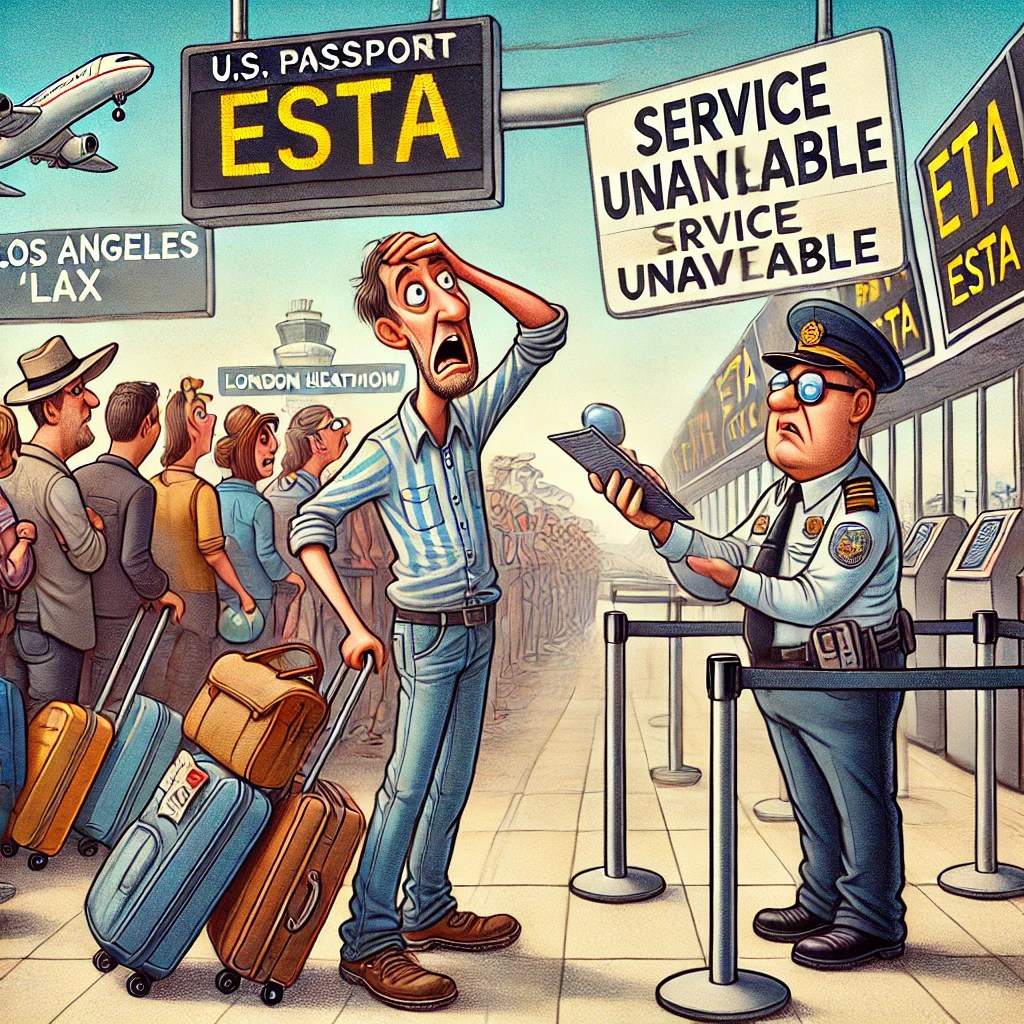
However, unlike the far more civilised EU approach to transit, this brief layover in LAX requires one to engage in the ever-thrilling experience of U.S. passport control—yes, even if you’re merely stretching your legs and not actually entering the country. As a bonus, this means applying in advance for an ESTA, the U.S. travel authorisation that generously demands a modest $21 fee for the privilege of existing within an airport terminal. Given the current state of affairs in the U.S.—administration cuts, government turmoil, and general chaos—I figured I’d better apply for my Electronic System for Therapy Aid (otherwise known as ESTA) as soon as possible, lest the system collapse before my request is processed.
To my astonishment, I applied yesterday afternoon without a hitch and received my authorisation almost immediately. A rare and unexpected efficiency—kudos, America!
Buoyed by this minor triumph, I decided to tackle the British equivalent today. As of April 2nd, the UK has introduced the ETA (Electronic Travel Authorisation), ensuring that passengers like myself must obtain official permission before being graciously allowed to wander into the country.
The UK, in its infinite wisdom, has designed a compulsory app-based system for this process, which I obediently downloaded. Upon launching the app, I was met with a message as quintessentially British as a queue outside a fish and chip shop: “Sorry, the service is busy. Try again later.”
Ah yes, the UK, home of world-class mediocre service, where one must be prepared to battle bureaucracy at every turn. I am scheduled to travel on April 1st, a date that now seems ominously appropriate. No doubt this entire situation is an elaborate April Fools’ prank by the British government, but unfortunately, I’m not laughing.
In the meantime, I shall persist, periodically hammering the refresh button on my phone like a lab rat in a dubious psychological experiment. With luck, I may yet be granted the immense privilege of passing through a UK airport without incident. Fingers crossed.
I have to be careful, though, and perhaps not too critical, because the EU is also introducing a similar system. As an EU citizen, I won’t have to use it, but I do wonder how effective it will be. Let’s hope it’s not a remake of the British or American administrative nightmare!
🇫🇷
Les joies du voyage aerien moderne
Une hoistoire de deux systèmes
Le mois prochain, j’aurai le plaisir de transiter par Los Angeles (LAX) en route de Paris vers le Pacifique Sud. Mon escale est brève – juste assez de temps pour que la compagnie aérienne exécute son ballet millimétré de changement d’équipage, de nettoyage de l’appareil et, surtout, de ravitaillement pour le prochain marathon aérien de 12 heures. Évidemment, il faut débarquer durant ce laps de temps, une occasion rêvée de dégourdir ses jambes et de faire une petite promenade jusqu’au salon Air France le plus proche pour une boisson rafraîchissante et une collation. Jusqu’ici, tout va bien.
Cependant, contrairement à l’approche bien plus civilisée de l’UE en matière de transit, cette brève escale à LAX nécessite de se frotter aux contrôles des passeports américains – oui, même si vous vous contentez d’étirer vos jambes et que vous ne mettez pas réellement un pied sur le territoire. Cerise sur le gâteau, il faut également faire une demande préalable d’ESTA, cette fameuse autorisation de voyage aux États-Unis qui exige la modique somme de 21 $ pour le privilège d’exister dans un terminal d’aéroport. Étant donné l’état actuel des choses aux États-Unis – coupes budgétaires, chaos administratif et autres réjouissances – j’ai jugé plus prudent de faire ma demande au plus vite avant que le service ne s’effondre complètement.
À ma grande surprise, j’ai soumis ma demande hier après-midi sans encombre et j’ai reçu mon autorisation presque immédiatement. Une efficacité rare et inattendue – bravo, l’Amérique !
Forts de ce succès, je me suis dit qu’il était temps d’affronter l’équivalent britannique. À partir du 2 avril, le Royaume-Uni a introduit l’ETA (Electronic Travel Authorisation), rendant obligatoire l’obtention d’un permis officiel même pour les passagers en simple transit.
Le Royaume-Uni, dans son infinie sagesse, a conçu un système exclusivement basé sur une application, que j’ai docilement téléchargée. En l’ouvrant, je suis accueilli par un message aussi typiquement britannique qu’une file d’attente devant une boutique de fish and chips : « Désolé, le service est occupé. Veuillez réessayer plus tard. »
Ah oui, le Royaume-Uni, berceau du service médiocre par excellence, où l’on doit s’attendre à devoir se battre contre la bureaucratie à chaque étape. Je suis censé voyager le 1er avril, une date qui semble soudainement bien ironique. Il ne fait désormais plus aucun doute que toute cette situation est une vaste plaisanterie du gouvernement britannique à l’occasion du poisson d’avril… mais malheureusement, je ne ris pas.
En attendant, je persévère, martelant régulièrement le bouton d’actualisation de mon téléphone comme un rat de laboratoire dans une expérience psychologique douteuse. Avec un peu de chance, j’obtiendrai peut-être le privilège incommensurable de traverser un aéroport britannique sans encombre. Croisons les doigts.
Je dois cependant faire attention et peut-être ne pas trop critiquer, car l’UE introduit également un système similaire. En tant que citoyen européen, je n’aurai pas à l’utiliser, mais je me demande bien quelle sera son efficacité. Espérons que ce ne soit pas un remake du cauchemar administratif britannique ou américain !
Quand j’étais au lycée – à une époque où les téléphones avaient des cadrans et où l’ordinateur personnel relevait encore de la science-fiction – on nous demandait de disserter sur l’impact des robots industriels. C’était les années 60, et ces nouvelles machines commençaient tout juste à s’infiltrer dans les usines, déclenchant une vague d’inquiétudes digne des meilleurs scénarios dystopiques.
La grande question de l’époque ? “Les robots vont-ils voler nos emplois et plonger l’humanité dans la misère ?” (Spoiler : ils en ont détruit certains, créé d’autres, et aujourd’hui, plus personne ne s’émeut d’un bras mécanique sur une chaîne de montage).
Avance rapide de quelques décennies, et nous voici en 2025, à rejouer exactement la même partition – cette fois avec l’intelligence artificielle. L’IA va-t-elle remplacer les travailleurs, ou simplement transformer le travail ? Va-t-elle démultiplier notre productivité, ou accroître les inégalités ? La technologie va-t-elle nous libérer ou nous aliéner ?
Robots vs. IA : Même combat, nouveaux débats
Bien que l’IA et les robots industriels soient des bêtes technologiques différentes, les craintes qu’ils suscitent sont étonnamment similaires.
1. Le spectre de la perte d’emplois
Dans les années 60, on imaginait déjà des usines entièrement automatisées où l’humain n’aurait plus sa place. Aujourd’hui, on craint que l’IA ne remplace non seulement les ouvriers, mais aussi les cols blancs – des avocats aux journalistes, en passant par les radiologues. Ironie du sort, ce sont justement les outils d’IA qui généreront probablement les dissertations des lycéens de demain sur ce sujet…
2. La sécurité et l’éthique
À l’époque, on s’inquiétait des ouvriers risquant de se faire broyer par des robots industriels mal calibrés. Aujourd’hui, on s’alarme des IA capables de diffuser des fake news à l’échelle mondiale, de perpétuer des biais discriminatoires ou de prendre des décisions critiques sans supervision humaine. En somme, le problème n’est plus mécanique, mais algorithmique.
3. L’impact économique : promesse ou mirage ?
Les robots industriels ont révolutionné la productivité manufacturière, augmentant les profits tout en réduisant certains emplois peu qualifiés. L’IA promet des gains similaires, mais avec le risque d’aggraver encore davantage les inégalités, en concentrant les richesses entre les mains de ceux qui contrôlent la technologie.
4. L’adaptation humaine : nécessité ou utopie ?
Dans les années 60, on prônait déjà la reconversion professionnelle et la formation pour préparer les travailleurs à un monde plus automatisé. En 2025, le discours est identique : apprendre à travailler avec l’IA plutôt que contre elle. Reste à savoir si cette transition sera plus réussie aujourd’hui qu’elle ne l’a été autrefois.
5. Les régulateurs à la traîne (comme toujours)
Tout comme il a fallu des décennies pour encadrer correctement l’usage des robots industriels, les régulateurs peinent à imposer des règles claires pour l’IA. La technologie évolue plus vite que les lois, et on se retrouve encore à courir derrière la machine.
Une leçon d’histoire… en boucle
L’histoire nous montre que la peur du changement est un réflexe humain. À chaque grande avancée technologique – de l’électricité à Internet en passant par les robots industriels – nous avons eu les mêmes débats, les mêmes angoisses… et pourtant, nous avons fini par nous adapter.
Alors, l’IA nous condamne-t-elle à la réédition de l’éternelle dissertation sur l’avenir du travail ? Probablement. Mais peut-être que, cette fois, nous pourrons enfin apprendre des leçons du passé et anticiper au lieu de subir.
Enfin, sauf si une IA décide d’écrire cette conclusion à ma place…
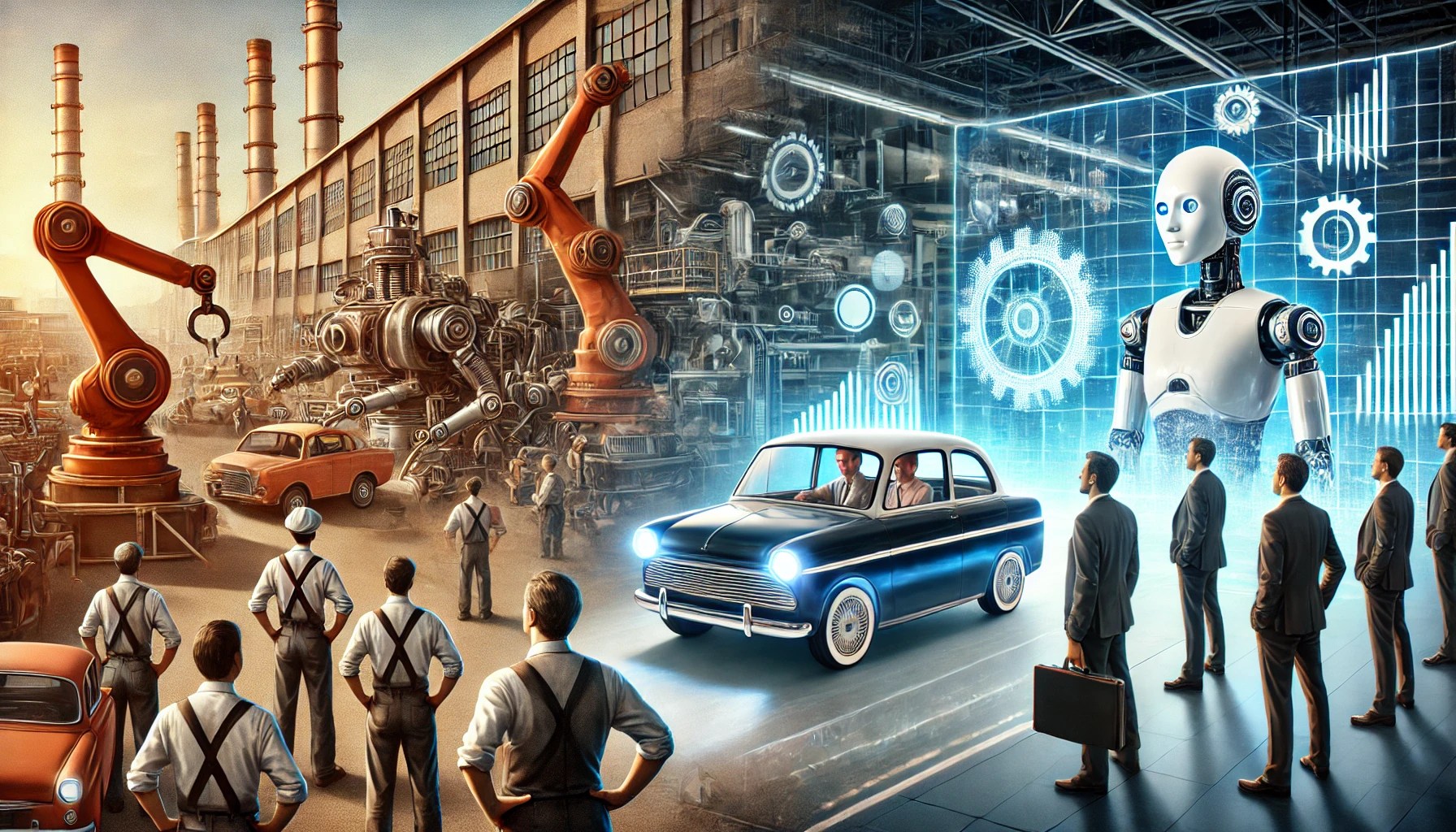
Designed by J2S created by Dalle-E 3
🇬🇧
Robots, AI, and technological Déjà Vu
A never ending story
When I was in high school—back when phones had rotary dials and personal computers were still science fiction—we were asked to write essays about the impact of industrial robots. It was the 1960s, and these new machines were just beginning to infiltrate factories, triggering a wave of anxiety straight out of a dystopian novel.
The big question at the time? “Will robots steal our jobs and plunge humanity into misery?” (Spoiler: they eliminated some jobs, created others, and today, nobody bats an eye at a robotic arm on an assembly line).
Fast forward a few decades, and here we are in 2025, playing the exact same tune—this time with artificial intelligence. Will AI replace workers or simply transform work? Will it boost productivity or widen inequality? Will technology free us or enslave us?
Robots vs. AI: Same Debate, New Era
Although AI and industrial robots are different technological creatures, the fears they spark are strikingly similar.
1. The specter of job loss
In the 1960s, people imagined fully automated factories where humans would have no place. Today, the fear is that AI won’t just replace factory workers but also white-collar professionals—lawyers, journalists, radiologists. Ironically, AI tools will probably generate the essays that future high school students write on this very topic…
2. Safety and ethics
Back then, the concern was that poorly calibrated industrial robots might crush workers. Today, we worry about AI spreading fake news globally, reinforcing biased decision-making, or making critical choices without human oversight. In short, the problem is no longer mechanical—it’s algorithmic.
3. Economic impact: promise or illusion?
Industrial robots revolutionised manufacturing productivity, boosting profits while displacing some low-skilled jobs. AI promises similar gains, but with the risk of further widening economic inequality by concentrating wealth in the hands of those who control the technology.
4. Human adaptation: necessity or fantasy?
In the 1960s, people were already advocating for retraining programs to prepare workers for an automated world. In 2025, the message is the same: learn to work with AI rather than against it. The real question is whether we’ll manage this transition more successfully this time around.
5. Regulators lagging behind (as always)
Just as it took decades to properly regulate industrial robots, lawmakers are struggling to set clear rules for AI. Technology advances faster than legislation, leaving us, once again, chasing after the machine.
A History Lesson… on Repeat
History shows us that fear of change is a deeply human reflex. With every major technological leap—from electricity to the internet to industrial robots—we’ve had the same debates, the same anxieties… and yet, we’ve adapted.
So, does AI doom us to an endless loop of essays about the future of work? Probably. But maybe, this time, we can finally learn from the past and prepare instead of panic.
Unless, of course, an AI decides to write this conclusion for me…
You know that feeling when you stumble upon something you completely forgot you owned? Like finding a 20€ bill in an old jacket, except in my case, it was a brand-new, untouched D15 Mini Drone—a relic from a past version of myself who, apparently, had ambitious aerial photography dreams.
The discovery happened thanks to my brother, who casually mentioned drones over lunch. He was talking about a friend’s son currently gallivanting around the world on a sabbatical, sending back breathtaking drone shots of exotic locations. That’s when it hit me—Wait a minute… don’t I have a drone too?
Fast forward to this evening: with my home office shelves finally in a state of organization (a rare occurrence), it took no time at all to locate the pristine, unopened box. Inside, my D15 Mini Drone lay in wait, as if to say, Ah, so you finally remembered me?
Determined to finally take it for a spin, I immediately set about recharging the batteries—because let’s be honest, the only thing worse than forgetting you own a drone is remembering you own one and realizing it’s completely dead.
Next step? Find my flying certificate. A couple of years back, I dutifully took the official online test and earned my wings (at least on paper). Now, I just need to unearth that proof of competence before I take to the skies.
And why the sudden urgency? Well, in a few weeks, I’ll be heading south—really south—to the French paradise islands in the South Pacific. The dream? To squeeze my drone into my (hopefully hand-luggage-friendly) bag and capture some breathtaking footage.
Of course, there’s one small detail: I have absolutely no idea how to fly it. But that’s what practice is for, right? If you need me, I’ll be the person in an open field, dodging trees, cursing under my breath, and trying very hard not to turn my drone into a very expensive, very short-lived boomerang.
Stay tuned for the inevitable tales of trial, error, and (fingers crossed) stunning aerial shots!
🇫🇷
Perdu et rretrouvé
L’histoire de mon Mini Drone retrouvé
Vous voyez ce moment où vous tombez sur un objet dont vous aviez totalement oublié l’existence ? Comme retrouver un billet de 20 € dans une vieille veste… sauf que dans mon cas, c’était un D15 Mini Drone, flambant neuf et encore dans sa boîte. Apparemment, il fut un temps où j’avais des ambitions de photographie aérienne.
Tout a commencé ce midi, lorsque mon frère a évoqué le sujet des drones au déjeuner. Il parlait du fils d’un ami, actuellement en tour du monde pour une année sabbatique, qui envoie régulièrement des photos à couper le souffle prises avec son drone. Et là, illumination : Attends… je n’ai pas, moi aussi, un drone quelque part ?
Ce soir, avec mes étagères de bureau fraîchement rangées (un exploit en soi), il ne m’a pas fallu longtemps pour remettre la main sur la boîte intacte. À l’intérieur, mon D15 Mini Drone patientait sagement, comme pour me dire : Ah, tu te souviens enfin de moi ?
Bien décidé à le faire voler cette fois-ci, j’ai immédiatement entrepris de recharger les batteries—car soyons honnêtes, il n’y a rien de pire que de se rappeler qu’on a un drone… pour découvrir qu’il est totalement à plat.
Prochaine étape ? Retrouver mon certificat de pilotage. Il y a quelques années, j’avais passé l’examen officiel en ligne et obtenu mon autorisation de vol (du moins, sur le papier). Il ne me reste plus qu’à remettre la main dessus avant de prendre mon envol.
Et pourquoi cet empressement soudain ? Parce que dans quelques semaines, je pars loin—très loin—vers les îles paradisiaques françaises du Pacifique Sud. Mon objectif ? Faire tenir mon drone dans mon bagage cabine (si tout se passe bien) et capturer des images dignes de cartes postales.
Petit détail, cependant : je n’ai absolument aucune idée de comment piloter ce truc. Mais c’est à ça que sert l’entraînement, non ? Si vous me cherchez, je serai quelque part dans un champ ouvert, en train d’éviter les arbres, de râler et d’essayer désespérément de ne pas transformer mon drone en boomerang hors de prix.
Restez connectés pour les récits (inévitables) de mes essais, erreurs et, avec un peu de chance, de superbes photos aériennes !
A month of movement, mild weather and musical holograms
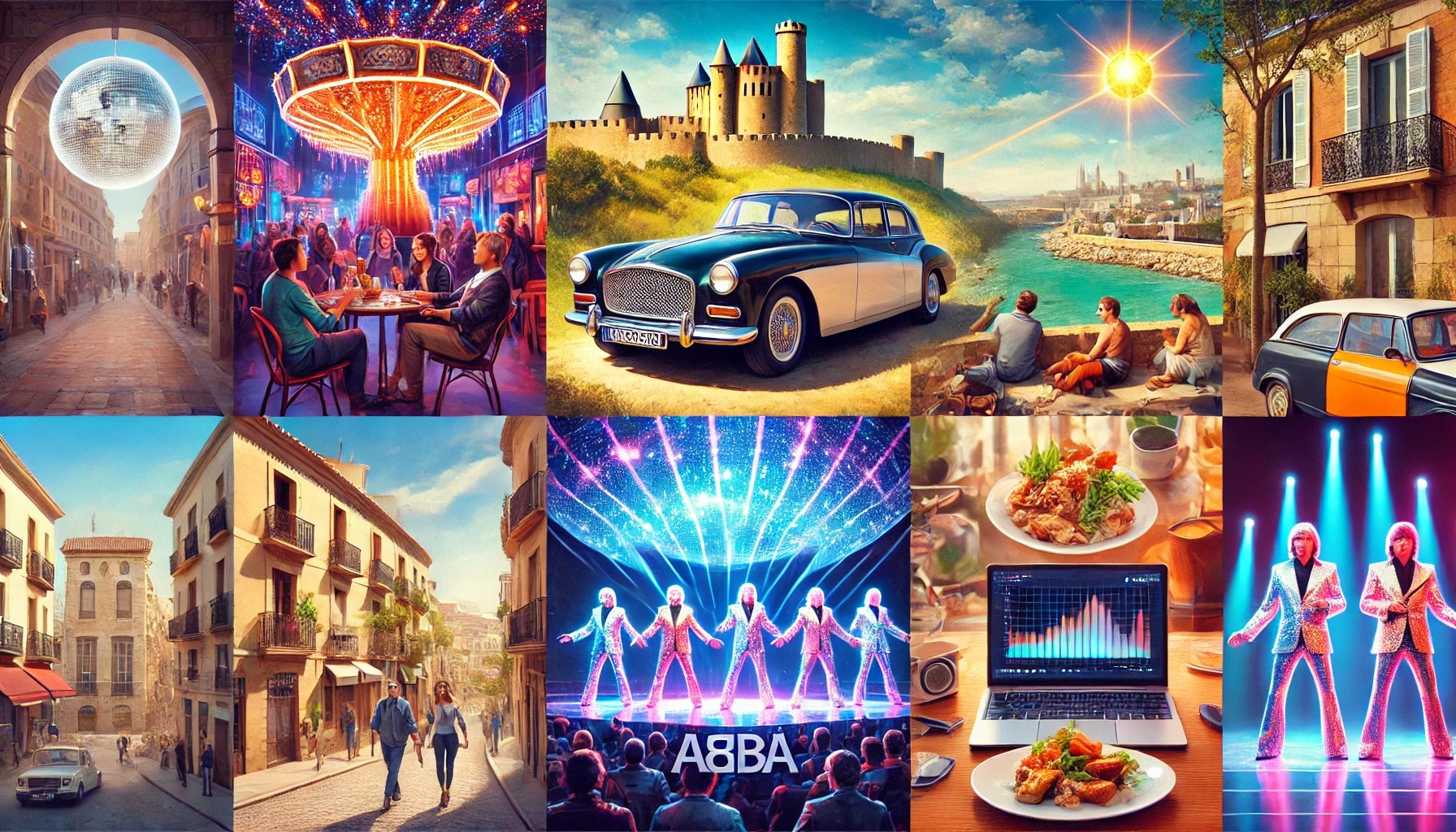
Ah, February—the shortest month, yet somehow always managing to pack in just as much (if not more) than its lengthier counterparts. This one started in spectacular fashion, with the annual—or at least almost annual—pilgrimage to Rétromobile in Paris. Of course, the classic car show was merely the official justification. The real reason? Reuniting with old friends, revisiting favorite haunts, and, naturally, indulging in the fine art of French gastronomy (and perhaps the occasional glass of something suitably decadent).
Back home in Carcassonne, the pace slowed, but only just. With a rare stretch of downtime, it was time for some much-needed IT upgrades and digital housekeeping—the kind of tasks that make one feel oddly accomplished without ever having to leave the house. The weather played its part too, offering a mild (if mostly grey) February, which felt like nature’s way of nudging us toward the next adventure.
And so, in search of a little more Vitamin D, a spontaneous escape to Barcelona was declared. An extended weekend in the Catalan capital proved the perfect antidote to cloudy skies—because when in doubt, tapas, sunshine, and Gaudí are always a good idea.
As the month wound down, an unexpected plot twist: my wife vanished to London to experience the ABBA Voyage virtual show, leaving me as a Strohwitwer (or “straw widower,” as the Germans charmingly put it). Three days of solo existence later, I can confirm: survival was achieved, though the fridge did look a little emptier than usual.
Looking ahead to 2026, the lure of an early spring in Alicante has proven irresistible, and so the search for a temporary Spanish retreat for a month has begun. February may have been brief, but it certainly didn’t lack excitement.
Bring on March!
🇫🇷
Février 2025
Un mois de mouvement, de douceur et d’hologrammes musicaux
Ah, février – le mois le plus court, mais qui, d’une manière ou d’une autre, parvient toujours à contenir autant (si ce n’est plus) que ses homologues plus longs. Ce mois-ci a commencé de manière spectaculaire, avec le pèlerinage annuel – ou presque – à Rétromobile, à Paris. Bien sûr, l’exposition de voitures classiques n’était que la justification officielle. La vraie raison ? Retrouver de vieux amis, revisiter ses lieux de prédilection et, bien sûr, s’adonner à l’art de la gastronomie française (et peut-être un verre occasionnel de quelque chose de convenablement décadent).
De retour à Carcassonne, le rythme s’est ralenti, mais de justesse. Grâce à un rare temps d’arrêt, il était temps de procéder à des mises à jour informatiques et à un nettoyage numérique indispensables – le genre de tâches qui donnent un étrange sentiment d’accomplissement sans avoir à sortir de chez soi. Le temps a également joué un rôle, en offrant un mois de février doux (bien que majoritairement gris), ce qui nous a donné l’impression que la nature nous poussait vers la prochaine aventure.
C’est ainsi qu’en quête d’un peu plus de vitamine D, une escapade spontanée à Barcelone s’est imposée. Un week-end prolongé dans la capitale catalane s’est avéré l’antidote parfait au ciel nuageux, car en cas de doute, les tapas, le soleil et Gaudí sont toujours une bonne idée.
À la fin du mois, un rebondissement inattendu s’est produit : ma femme s’est volatilisée à Londres pour assister au spectacle virtuel ABBA Voyage, me laissant comme Strohwitwer (ou « veuf de paille », selon l’expression charmante des Allemands). Trois jours d’existence en solitaire plus tard, je peux confirmer que j’ai survécu, même si le réfrigérateur semblait un peu plus vide que d’habitude.
En prévision de 2026, l’attrait d’un printemps précoce à Alicante s’est avéré irrésistible, et la recherche d’une retraite espagnole temporaire d’un mois a donc commencé. Le mois de février a peut-être été bref, mais il n’a certainement pas manqué d’enthousiasme.
Après une escapade délicieuse, bien que bien trop courte, à Barcelone, une idée mûrit dans mon esprit—une idée qui, comme un bon vin, ne fait que s’améliorer avec le temps. Février, ce mois morne, gris et généralement peu inspirant, mérite une mise à niveau. Et quel meilleur moyen d’échapper à son emprise que de descendre encore plus au sud ? Alicante, avec son climat doux et son atmosphère accueillante, semble soudain être l’évasion parfaite.
Je suis déjà passé par Alicante à quelques reprises, mais toujours en coup de vent. Pourtant, chaque visite m’a laissé une impression marquante—celle d’une ville animée, chaleureuse et, point essentiel, dotée d’un restaurant indien fabuleux niché dans la vieille ville. (Les priorités, bien sûr.) En plus de cela, elle possède une histoire fascinante, un charme indéniable et, surtout, une situation stratégique pour traquer le soleil hivernal.
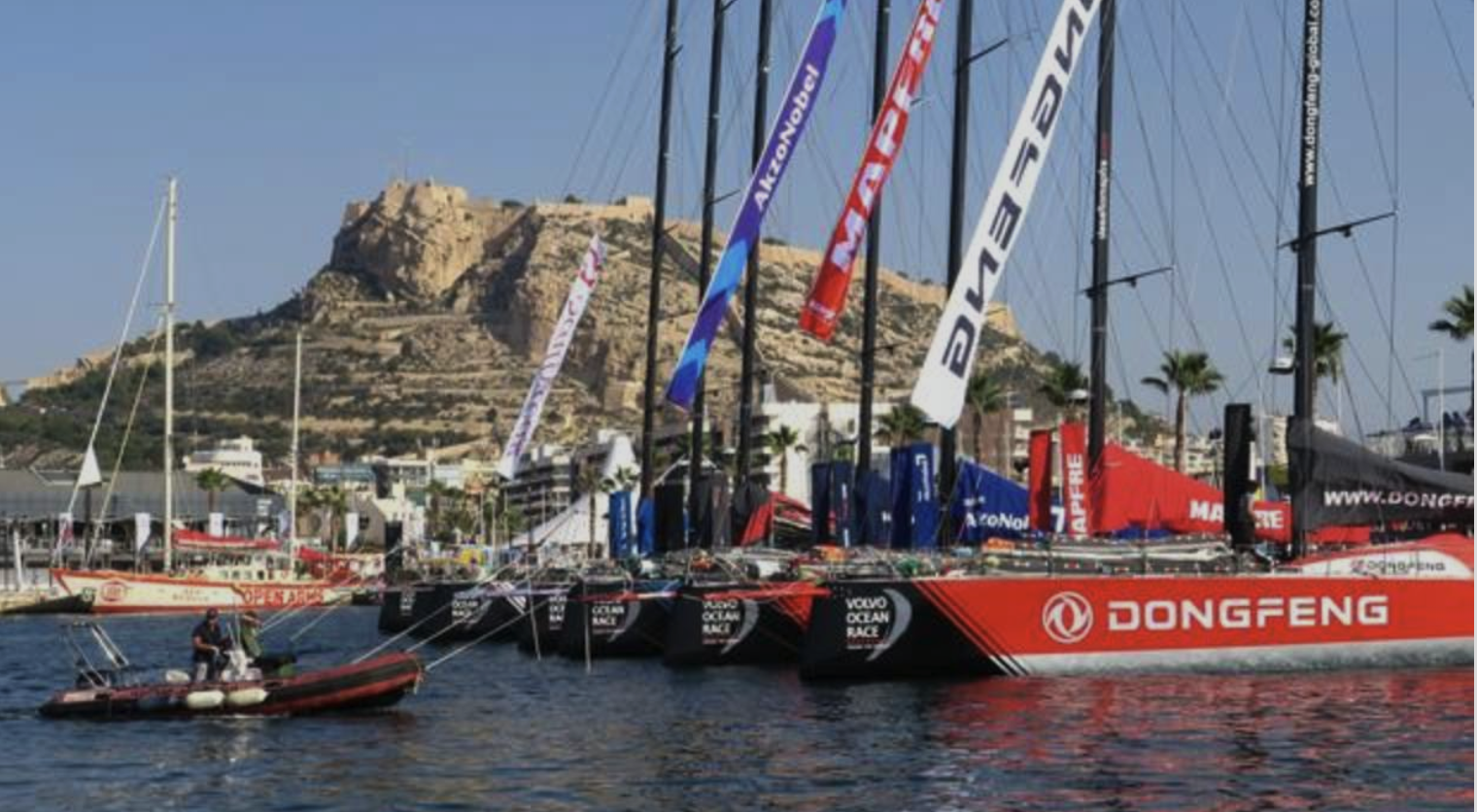
Autre atout de poids : j’ai des amis qui vivent—ou du moins vivaient—à quelques kilomètres de là. Il y a quelques années, j’ai pris soin d’aller les voir, attiré par le spectacle du village de la Volvo Ocean Race. Observer ces magnifiques bateaux se préparer pour leur épopée autour du monde était tout simplement impressionnant. Peut-être qu’une partie de cet esprit d’aventure m’a gagné, car aujourd’hui, l’idée de m’installer là-bas pour un mois prend de l’ampleur.
Et ainsi commence la phase de recherche. Quelles sont les options ? Où ? Et surtout—à quel prix ? Les critères sont simples mais impératifs : un espace suffisamment grand pour accueillir les amis et la famille tentés par la grande évasion de février. Car soyons honnêtes, l’idée de siroter un café sur une place ensoleillée pendant que d’autres affrontent le froid et la pluie est trop belle pour la garder pour soi.
Je sens qu’un plan se forme. Un plan rusé, baigné de soleil et parfait pour échapper à la grisaille hivernale.
Affaire à suivre.
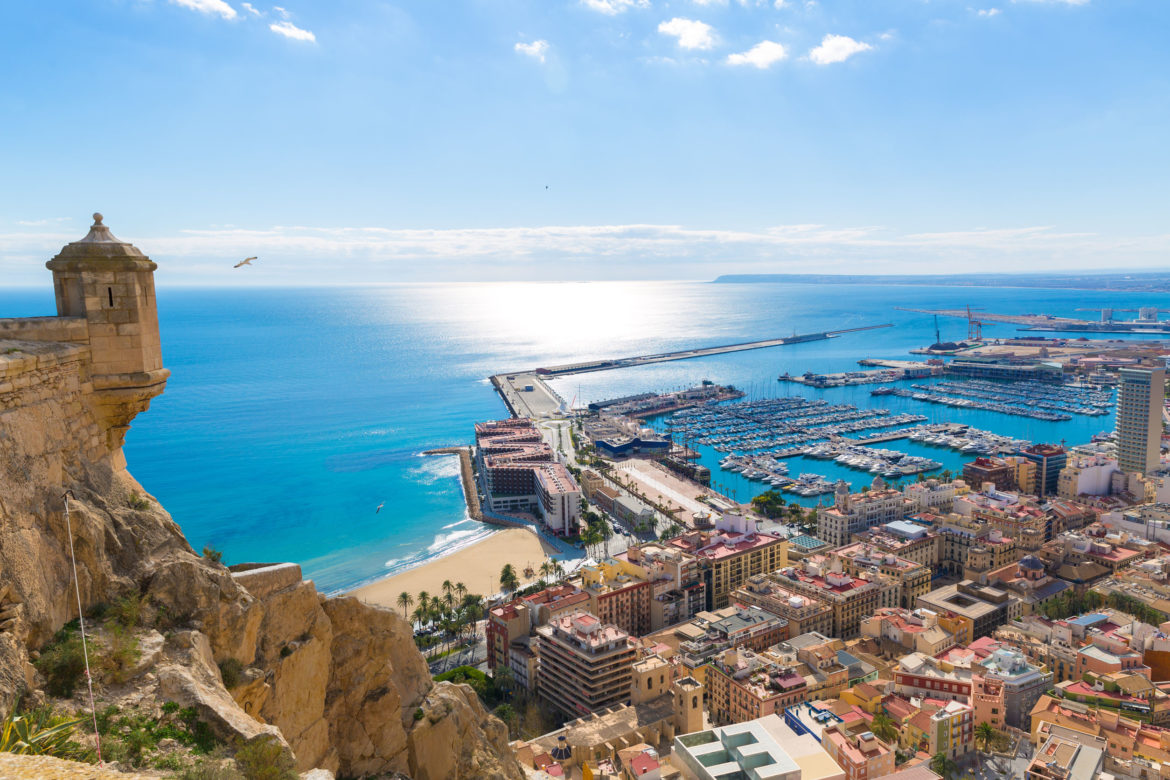
Alicante skyline aerial view from Santa Barbara Castle in Spain
🇬🇧
A plot takes shape for 2026
After a delightful, albeit far too fleeting, jaunt to Barcelona, a thought has been brewing in my mind—one that, like a well-aged wine, only improves with time. February, that dreary, grey, and generally uninspiring month, is simply begging for an upgrade. And what better way to escape its clutches than by heading even further south? Alicante, with its mild weather and inviting atmosphere, is suddenly looking like the perfect getaway.
I have been to Alicante a couple of times before, albeit in a passing-through sort of way. Yet, each visit left an impression—one of a city that hums with life, radiates warmth, and, crucially, has a fantastic Indian restaurant tucked away in the old town. (Priorities, of course.) More than that, it has history, charm, and a rather strategic location when it comes to winter sun-seeking.
Adding to its appeal, I have friends who live—or at least used to live—just a few miles away. A few years back, I made a point to visit them, drawn by the spectacle of the Volvo Ocean Race village. Watching those magnificent boats prepare for their epic, round-the-world battle was nothing short of awe-inspiring. Perhaps some of that adventurous spirit has rubbed off on me, because now, the idea of relocating for a month is gaining momentum.
And thus, the research phase begins. What’s available? Where? And most importantly—how much? The requirements are simple yet non-negotiable: a space large enough to host friends and family who may be tempted to join in the great February escape. Because let’s be honest, the idea of sipping coffee in a sunlit plaza while others battle frost and drizzle back home is too good to keep to oneself.
I feel a plan forming. A cunning, sun-drenched, escape-the-winter-blues kind of plan.
Watch this space.
🇩🇪
Ein Plan formt sich
Nach einem herrlichen, wenn auch viel zu kurzen, Abstecher nach Barcelona reift in meinem Kopf eine Idee—eine Idee, die wie ein guter Wein mit der Zeit nur besser wird. Der Februar, dieser triste, graue und meist wenig inspirierende Monat, braucht dringend ein Upgrade. Und was wäre besser, als ihm zu entkommen, indem man noch weiter nach Süden reist? Alicante, mit seinem milden Klima und seiner einladenden Atmosphäre, erscheint plötzlich als die perfekte Flucht.
Ich war bereits ein paar Mal in Alicante, allerdings nur auf der Durchreise. Dennoch hinterließ jeder Besuch einen bleibenden Eindruck—eine Stadt voller Leben, Wärme und, ganz wichtig, mit einem hervorragenden indischen Restaurant in der Altstadt. (Prioritäten, natürlich.) Darüber hinaus hat sie Geschichte, Charme und eine geradezu strategische Lage für alle, die im Winter die Sonne suchen.
Ein weiterer Pluspunkt: Ich habe Freunde, die dort leben—oder zumindest früher dort lebten—nur wenige Kilometer entfernt. Vor einigen Jahren habe ich sie besucht, speziell um das Volvo Ocean Race-Dorf zu sehen. Die beeindruckenden Boote, die sich auf ihre epische Weltumsegelung vorbereiteten, waren schlichtweg atemberaubend. Vielleicht hat mich dieser Abenteuergeist ein wenig angesteckt, denn die Idee, für einen Monat dorthin zu ziehen, gewinnt zunehmend an Reiz.
Und so beginnt die Recherchephase. Was gibt es für Angebote? Wo? Und vor allem—zu welchem Preis? Die Anforderungen sind einfach, aber nicht verhandelbar: ausreichend Platz, um Freunde und Familie unterzubringen, die sich der großen Februar-Flucht anschließen möchten. Denn sind wir ehrlich—die Vorstellung, in einem sonnigen Café zu sitzen, während andere sich mit Kälte und Nässe herumschlagen, ist einfach zu gut, um sie alleine zu genießen.
Ich spüre, dass sich ein Plan zusammenbraut. Ein raffinierter, sonnenverwöhnter Plan, um den Winterblues zu entkommen.
The week kicked off—quite literally—with a spectacularly short night, courtesy of my Tennessean friend and almost-neighbor, Charlie. He extended an invitation to watch Super Bowl LIX, an offer I could hardly refuse. As previously noted, kickoff in CET-friendly time zones is a rather brutal 00:30, and with a solid three hours of game time, let’s just say Monday morning was met with bleary eyes and an extra-strong coffee.
After the excitement of touchdowns and halftime show dramatics, the rest of the week took on a more relaxed tone—one which, I must admit, I quite enjoy. While gallivanting across exotic locales has its charm, there’s something deeply satisfying about the simple pleasures of a well-oiled daily routine.
This week’s mission: advancing my knowledge of Artificial Intelligence. I delved into four different AI applications: Microsoft’s CoPilot (once my undisputed favorite), OpenAI’s ChatGPT, the much-discussed Chinese DeepSeek, and a new contender that piqued my interest—LeChat de Mistral, a creation of French ingenuity.
Now, I wouldn’t call myself a chauvinist (not overtly, at least), but I must say, LeChat de Mistral has impressed me tremendously. Its ability to generate hyper-realistic test images was the best I’ve encountered so far. Of course, as with any tool, my own growing expertise in crafting prompts is likely playing a role in the improved results.
Thursday came with its usual joy—my monthly injection, which, as tradition dictates, knocked me off my feet for a bit. Not to worry, full recovery has since been achieved. Meanwhile, on the more exciting front, my better half dedicated a substantial chunk of time to plotting our autumn expedition to Ireland. Flights? Booked. Rental car? Secured. Accommodations? Sorted. We’ll be six on this Emerald Isle adventure, and I can already envision the Guinness flowing and the landscapes dazzling.
To round off the week, I found myself diving deep into the world of music, curating and updating playlists. From the thunderous riffs of ‘70s rock to the spine-tingling beauty of classical masterpieces, my auditory senses were thoroughly indulged.
And just when I thought the week couldn’t get any more satisfying, the weather decided to throw in a little teaser of spring. Encouraged by the milder temperatures, I spent a couple of hours in the courtyard/garden, tidying up plants and basking in the fleeting promise of warmer days ahead.
All in all, a well-balanced week—thrilling sports, intellectual pursuits, meticulous travel planning, and the joy of good music. What more could one ask for?
🇫🇷
Super Bowl, aventures en IA & un soupçon de printemps
La semaine a commencé—au sens propre—par une nuit spectaculairement courte, gracieuseté de mon ami tennessean et presque voisin, Charlie. Il m’a invité à regarder le Super Bowl LIX, une offre difficile à refuser. Comme mentionné précédemment, le coup d’envoi à l’heure CET est un redoutable 00:30, et avec trois bonnes heures de jeu, disons que le lundi matin a été accueilli avec des yeux fatigués et un café extra-fort.
Après l’excitation des touchdowns et des rebondissements du spectacle de la mi-temps, le reste de la semaine a pris une tournure plus détendue—ce qui, je l’avoue, me plaît bien. Bien que l’exploration de contrées exotiques ait son charme, il y a quelque chose de profondément satisfaisant dans les plaisirs simples d’une routine bien rodée.
La mission de cette semaine : approfondir mes connaissances en intelligence artificielle. Je me suis plongé dans quatre applications différentes : CoPilot de Microsoft (autrefois mon favori incontesté), ChatGPT d’OpenAI, le très discuté DeepSeek chinois, et un nouveau venu qui a attiré mon attention—LeChat de Mistral, une création du génie français. Je ne me prétends pas chauvin (pas ouvertement, du moins), mais je dois dire que LeChat de Mistral m’a énormément impressionné. Sa capacité à générer des images test hyperréalistes est la meilleure que j’aie rencontrée jusqu’à présent. Bien sûr, comme pour tout outil, ma propre expertise croissante dans l’élaboration de prompts joue probablement un rôle dans l’amélioration des résultats.
Le jeudi est arrivé avec sa joie habituelle—mon injection mensuelle, qui, comme le veut la tradition, m’a mis à plat pendant un moment. Pas d’inquiétude, la pleine récupération a été atteinte depuis. Pendant ce temps, sur une note plus enthousiasmante, ma moitié a consacré un temps considérable à planifier notre escapade automnale en Irlande. Vols ? Réservés. Voiture de location ? Sécurisée. Hébergements ? Organisés. Nous serons six à partir à l’aventure sur l’île d’Émeraude, et j’imagine déjà la Guinness couler à flots et les paysages nous émerveiller.
Pour clôturer la semaine, je me suis plongé dans le monde de la musique, en mettant à jour et en enrichissant mes playlists. Des riffs tonitruants du rock des années 70 à la beauté frissonnante des chefs-d’œuvre classiques, mes sens auditifs ont été pleinement comblés.
Et juste au moment où je pensais que la semaine ne pouvait pas être plus satisfaisante, la météo a décidé de nous offrir un avant-goût du printemps. Encouragé par des températures plus douces, j’ai passé quelques heures dans la cour/jardin à ranger les plantes et à profiter de la douce promesse de jours plus chauds à venir.
En somme, une semaine bien équilibrée—un sport palpitant, des explorations intellectuelles, une planification méticuleuse de voyage et le plaisir d’une bonne musique. Que demander de plus ?
Tropical islands—they’re the stuff of dreams and the source of endless holiday envy. During my expat stint in Shanghai, I found myself with a few days off and a hankering for something different. Enter Sanya, a destination that was as mysterious to me as it was alluring. I had zero expectations and even less of an idea of what awaited me. Boy, was I in for a surprise!
Picture this: a modern Chinese island that could give any high-end Western resort a run for its money. Scattered along the coast were sleek hotels boasting every facility you could imagine. The beaches? Immaculate and blissfully empty. The welcome? Simply superb. Our room was a dream, complete with a large suite balcony that offered a view of an atomic submarine facility in the distance—a quirky reminder that we were indeed in China.
I had such a fantastic time that I couldn’t help but rave about it to my colleagues. Before I knew it, I had convinced our management team to hold our next team-building exercise there. Who needs trust falls when you’ve got paradise at your fingertips?
This morning, a message from Amazon Photos brought it all rushing back. A couple of snapshots from February 14th, 15 years ago, reminded me of those sun-soaked days in Sanya. Great memories indeed.
So, if you ever find yourself with a few days to spare and a craving for the unexpected, take a chance on Sanya. You never know what hidden gems you might uncover.
🇫🇷
Paradis inattendu
Inoubliable Sanya
Les îles tropicales—elles sont le rêve de tous et la source d’une envie de vacances infinie. Pendant mon séjour d’expatrié à Shanghai, je me suis retrouvé avec quelques jours de congé et une envie de quelque chose de différent. C’est alors que j’ai découvert Sanya, une destination qui m’était aussi mystérieuse qu’attirante. Je n’avais aucune attente et encore moins d’idée de ce qui m’attendait. Quelle surprise !
Imaginez ceci : une île chinoise moderne qui pourrait rivaliser avec n’importe quelle station balnéaire de luxe occidentale. Éparpillés le long de la côte, des hôtels élégants offrant toutes les commodités imaginables. Les plages ? Immaculées et merveilleusement vides. L’accueil ? Tout simplement superbe. Notre chambre était un rêve, avec un grand balcon de suite offrant une vue sur une installation de sous-marins atomiques au loin—un rappel pittoresque que nous étions bien en Chine.
J’ai passé un moment si fantastique que je n’ai pas pu m’empêcher d’en parler à mes collègues. Avant même de m’en rendre compte, j’avais convaincu notre équipe de direction d’organiser notre prochain exercice de renforcement d’équipe là-bas. Qui a besoin de jeux de confiance quand on a le paradis à portée de main ?
Ce matin, un message d’Amazon Photos m’a replongé dans ces souvenirs. Quelques photos du 14 février, il y a 15 ans, m’ont rappelé ces journées ensoleillées à Sanya. De merveilleux souvenirs, vraiment.
Alors, si vous vous retrouvez avec quelques jours de libres et une envie d’inattendu, tentez votre chance à Sanya. Vous ne savez jamais quels trésors cachés vous pourriez y découvrir.