The small manufacturer from Sarthe became big. With a more reliable engine and a slightly modified aerodynamic system, Jean Rondeau achieved a feat that is still unequalled today. The Manceau, exhausted at the end of the race, was taken over by Jean Pierre Jaussaud in the last two stints to stabilise the gap with the Ickx Porsche. The victory at the end of this race is a consecration for the Sarthe team.
Anyway, the postman has just been and delivered my latest acquisition
▫️ JEAN CASTEX In an exclusive interview with Le Parisien (article for subscribers) on Monday May 10th, the Prime Minister, Jean Castex, welcomed the gradual decline of the Covid-19 epidemic in France and announced the step by step planned deconfinement procedure.
🔸 May19th
For restaurants, cafés and bars. The terraces of these establishments will reopen at 50% of their capacity on 19 May, with tables seating a maximum of six people. The latter must remain seated.
For shops. All shops considered non-essential during the containment period will be able to reopen on 19 May. One customer at a time will be allowed in shops of less than 8 m2, and a minimum of 8 m2 per customer will be required for larger shops. The rule will be the same for open markets, and will be 4 m2 per person for outdoor markets.
For museums. An 8 m2 per person capacity is also planned for the reopening of museums on 19 May.
For cinemas and theatres. These cinemas will once again be open to the public on 19 May, with a maximum capacity of 35% and a ceiling of 800 spectators, according to Matignon in Le Parisien. This rule will also apply to village halls and multi-purpose rooms.
For religious ceremonies and civil weddings. These ceremonies will be able to take place with only one seat out of three occupied, and will be staggered from one row to the next.
For sports halls and swimming pools. These establishments will be able to reopen from 19 May for “priority users” such as minors, says Le Parisien. The capacity will be 35% for the public, and a ceiling of 800 spectators will be established.
🔸 June 9th
For restaurants, cafés and bars. For the second stage of these reopenings, on 9 June, the terraces will be able to reopen in their entirety, although tables for a maximum of six people will be maintained. The rooms of these establishments will also be able to reopen, with a capacity of 50% and tables of a maximum of six people.
For shops. The capacity per customer will be reduced from 8 m2 to 4 m2 on 9 June, both in shops and in indoor markets. It is lifted for outdoor markets.
For museums. As for shops, the size of the booth will be 4 m2 per person in museums from 9 June.
For cinemas and theatres. The capacity of cinemas and theatres will increase from 35% to 65% on 9 June, with a maximum capacity of 800 to 5,000 people. From 1,000 people, a health pass will be applied, says Le Parisien. These rules will also apply to village halls and multi-purpose halls.
For religious ceremonies and civil weddings. One seat out of two, as opposed to one out of three previously, may now be occupied.
For sports halls and swimming pools. Non-priority persons will have access to these establishments for “non-contact” sports, with a 50% capacity, explains Le Parisien. This will be 65% for the public, and the maximum number of spectators will rise from 800 to 5,000. A sanitary pass will be required for any reception of more than 1,000 spectators.
🔸 June 30th
For restaurants, cafés and bars. Rooms in these establishments will be allowed to open fully, while ensuring that barrier gestures and physical distancing are maintained. A health protocol will be applied according to the epidemic situation on that date.
For businesses. 30 June should mark, in principle, the end of the gauges in shops and markets, says Matignon.
For museums. Gauges will no longer be necessary in museums, but the government is calling for the maintenance of physical distancing measures and the respect of barrier gestures in these establishments.
For cinemas and theatres. These places will be able to receive the public without a gauge from 30 June, still respecting the physical distancing and barrier gestures. A health pass will continue to be applied for any event gathering more than 1,000 people.
For religious ceremonies and civil weddings. All seats will be available from 30 June.
For sports halls and swimming pools. All sports will be allowed in these facilities, and the public capacity will increase to 100% on 30 June. A health pass will still apply.
For stand-up concerts and festivals. From 30 June, standing concerts will be allowed again, with a maximum number of participants to be set by the prefect. A health pass will be required for any concert with more than 1,000 spectators. As for festivals, they will be able to resume with a capacity of 4m2 per participant, and a ceiling of festival-goers. Here too, a health pass will be required for more than 1,000 participants.
▫️ INCIDENCE RATES
In the Aude departement, the incidence rate is down to 131,74
In the Aude, this Sunday evening, the figures are stable compared to Saturday. 125 people were hospitalised: 60 in conventional hospital, 12 in intensive care, 52 in follow-up or long-term care and 1 in other facilities. No additional deaths were recorded on Sunday. In total, 349 people have died from Covid in the department.
In the Pyrénées-Orientales, 151 patients were hospitalised this Sunday (+6 in 24 hours): 71 in conventional hospitalisation (+5), 21 in intensive care (-1 compared to Saturday), 56 in follow-up care or long-term care (the same as Saturday) and 2 in other structures. No additional deaths were reported in the Pyrénées-Orientales on Sunday. The department counts 301 victims of Covid.
In the Occitanie region, this Sunday evening, 1,562 people are hospitalized because of the Covid (+6 in 24 hours): 778 in conventional hospitalization (+6), 319 in intensive care (+2), 442 in follow-up or long-term care (2 less than Saturday) and 23 in other sectors. In total, 4,295 inhabitants of the Occitanie region have died from Covid-19, including 6 in the last 24 hours.
▫️ Interview Mr Veran this morning
Do not weaken. While the number of patients in critical care units has just fallen back below the 5,000 mark, Olivier Véran was satisfied on Monday that the epidemic was “continuing to decline” in France. However, the Health Minister warned that the virus “is still circulating at a high level”, hence the need for the French not to relax in applying barrier measures.
“Our strategy is first to inform the French, they have known for 15 months, on the need to be careful for themselves and for others,” he said on LCI. As such, he “calls on them, while there will be a long weekend of four days, not to hesitate to be tested in pharmacies, laboratories, via self-tests or PCR tests. “We will be deploying hundreds of thousands of tests and self-tests in the coming days for those who wish to do so,” he said.
Always conducive to family gatherings, the Ascension Bridge could be a “pivotal weekend”, according to Olivier Véran. “We want to get together, see our parents, change departments and enjoy the period,” the minister argues. “It is an important period, we are not going to compromise it by doing anything. But I am convinced that the French have the keys to reading and understanding and will be responsible,” he concluded.
For several days, the health situation in France has been improving. The number of Covid-19 patients in critical care units (intensive care units, intensive care units and continuous surveillance units) in France has fallen back below the symbolic 5000 mark (4,971). The number of deaths, the positivity rate and the incidence rate: all the other indicators have been falling recently, raising hopes that the crisis will be over by the summer. This optimism is all the more justified as the vaccination campaign continues to accelerate (17,692,900 first doses injected, 8,198,987 second doses).
Someone mentionned this bike on TV last night. I had completely forgotten I had one. In fact I cannot remember anyone else in our area / town, Paris even.
Vaccines for the over 50s: The first announcement is that all French people over 50 without comorbidities will be able to be vaccinated from Monday May 10th. Appointments will begin to be made from Friday May 7th on the health.fr website.
This is five days earlier than the initial schedule, which was to see the first injections for this category of the population starting on May 15th.
Vaccination allowed “without age limit” in case of remaining doses Another important announcement, Emmanuel Macron authorises from Wednesday 12 May all French adults without “age limit” and without comorbidities to be vaccinated when there are still doses available.
▫️ CERTIFICATE OF VACCINATION
Since May 3rd 2021, anyone vaccinated against Covid-19 can ask the health professional to give them a certified paper certificate of vaccination at the time they receive the vaccine. This certificate includes a QR code that allows the vaccination to be registered in the AllAntiCovid booklet. This is the first step towards the European “health pass” or “digital green certificate”.
▫️ INCIDENCE RATES
The picture appears to get better all the time. The incidence rate however is only one of the main indices to be taken into account. Nevertheless, it looks much better than 3 days ago.
▫️ 17 DAYS OF ISOLATION?!
We learn something new every day with the virus. It never stops mutating, changing, being where we don’t necessarily expect it to be. On the containment measures to be respected, we must also follow. Between the attestation which is no longer necessary during the day, but which remains imperative in the evening for the curfew, between the different dates of return to “normal” (who opens when? On 19 May the zoos open, but the amusement parks will wait until 9 June, it was specified this morning for example), between the 10 km rule around one’s home which is over, one is not always sure what to do! Did you think the quarantine lasted 10 days for contact cases? Well, no. As far as isolation is concerned, we all have in mind when we are a contact case and the social security calls us, that we have to shut ourselves up at home for 10 days. Well no, it’s not always that number. So when you live with someone who develops the disease, it’s 17 days without seeing anyone! The idea is obviously to stop the chain of contamination. It is therefore imperative to be tested again (after a first negative test after a few days with the infected person), seven days after the end of the quarantine of the patient. Because you may have been infected during this period! In short, a patient confines himself for ten days, his relative for seventeen (or even 27 if the last test is positive)…
Not easy to follow, I tell you.
▫️ DIX VINS PLAGE
I was a bit concerned yesterday of the lack of activity on the beach where one of my favorite beach should be. Sigh of relief today, I have it from good authority, Laure herself, that work has actually started today and that the grand opening for the season is scheduled for May 29th. No doubt we shall patronise the place a few times during the summer.
▫️ MUSICOF 1969
Another top hit in France at the time. It was a really new sound for us.
🎶 / 🎶 / 🎶
▫️ SATIRE
▫️ NEWS FROM ACROSS THE POND 🇺🇸
▫️ EU NEWSFrom our correspondant in Allegan County, Mi 🇺🇸
My latest purchase of French cars which took part in the Le Mans 24 Hours over the years has just been delivered. I remember clearly being at the track when this car won.
Now I hesitate for the next purchase. I wish to go back further in time. The little Renault 4CV is very tempting but so is the Bugatti.
The older the cars, the more expensive the miniatures are.
I think I shall open up a list of all the models I wish to get. That should keep me busy.
As of yesterday evening, there were no departements in France with an Incidence Rate larger than 400, this means that based on this information only, the announced deconfinement steps can go ahead in all regions.
▫️ CARTE DE SEJOUR
I know a couple of people who received their “Carte de Séjour” today and a few more who are expecting theirs in the coming days.
In the event of an identity check or during administrative procedures, only certain official documents are valid to prove your identity.
By the way, this post is aimed at the Brits who do not really know what an national ID card is.
The point is that if you are of foreign nationality, you can, in the same way as the French, present an identity card or passport issued by your country of origin. Your residence permit / “Carte de séjour” is also a valid document.
It is probabbly a better idea to carry your Carte de Séjour in your wallet rather than your passport.
▫️ NAPOLEON BONAPARTE
So yesterday May 5th was the bi-centennial commemoration of the Emperor’s death. Liked or not, he is an important figure of the past.
Yesterday, President Macron marked the 200th anniversary of his death by telling France the controversial former emperor “is part of us”.
This is very important for those aspiring to obtain French Nationality and again I know a few. Napoleon Bonaparte is a part of France. He is also an Emperor who revolutionised the way we live today.
Here are some 10 contributions that the child of Ajaccio has made that have changed France, Europe and the world.
▪︎ Street numbering Like many people, your postal address is like “12 Rue de …”? The number that precedes your street name was introduced by Napoleon during his reign. The aim was not to improve the distribution of mail but to better organise the collection of the tax which was used to finance the countless wars that the Emperor was waging in the four corners of Europe.
▪︎ The sale of Louisiana to the United States
If the United States is the second world power today, it is thanks to Napoleon. He sold them the state of Louisiana, which belonged to France at the time. At the time, Louisiana represented half of the American territory as we know it today.
▪︎ The baccalauréat The famous philosophy subject, the screams, the tears when the results are announced… the Baccalauréat is the diploma that traumatizes everyone. Stress for teenagers, frustration for parents who have to wait until July to go on holiday. What a surprise to learn that this diploma was invented by a decree of Napoleon in October 1808. Surely the Emperor wanted to keep the tourists away from Ajaccio when he used to go back to Corsica to recharge his batteries in his Milelli residence…
▪︎ The Civil Code It is probably one of his most remarkable contributions to humanity. Under the Ancien Régime, each region of France dictated its own laws, which complicated relations between the different parts of the kingdom. At the beginning of the Revolution, the French deputies decided to draw up a common code for all citizens. This code was drafted in only one month, but it was not implemented until after the coup d’état of 19 Brumaire (10 November 1799), when Napoleon ended the Revolution and established the Consulate. As soon as he took power, he appointed a commission of four magistrates to synthesise the draft drawn up during the Revolution. After 109 sessions of discussion, the Council of State promulgated the Civil Code on 21 March 1804.
▪︎ L’Arc de Triomphe The postcard of Paris was erected under the orders of the Corsican Emperor. This place had a double symbolic significance for him. Firstly, in the aftermath of the battle of Austerlitz, considered to be Napoleon’s tactical and military “masterpiece”, the aim was to perpetuate the memory of the victories of the French Army. Secondly, before the enlargement of Paris in 1860, the land on which the Arc de Triomphe was built was on the border of the city, and offered a privileged access to the Emperor’s residence, which was the Tuileries Palace, located at the end of the Champs-Élysées. In addition to the commemorative aspect, the Arc de Triomphe was also the gateway to the Emperor’s home.
The Arc de Triomphe was the scene of violence and damage during the “gilets jaunes” demonstrations on Decembre 1st 2018 . The damage was significant, one million euros of damage and five works of art damaged.
▪︎ Rubbish collection At the end of the 17th century, the hygienist movement began to suspect that the air carried all sorts of viruses and microbes that could be dangerous to health. It was by a decree published on 15 October 1810 that Napoleon introduced the collection of rubbish in order to reduce the risk of viruses created by the bad smells in the air.
▪︎ The Lycées In 1802, he created the first lycée so that fathers could concentrate more on their work and less on the education of their sons. This education was provided by the state with the aim of making the child fit for military or administrative duties, or to help his parents in the performance of their tasks.
▪︎ The Universities After the progression of secondary education made possible by the creation of the Lycées, Napoleon wanted to go further by creating a strong institution that bore his name: the Napoleonic University. The first French universities were created in 1806, more than 40 years after Pasquale Paoli opened the University of Corsica.
▪︎ The departments To facilitate administration within the kingdom, the Assembly decides to divide France into 83 départements. Their size is established so that each citizen can reach his or her capital within a day’s ride.
▪︎ The Legion of Honour Finally Napoleon Bonaparte created the National Order of the Legion of Honour on 19 May 1802. The aim was to reward the merits of citizens, whether civilian or military, for the good deeds they had established. More than 200 years later, more than 93,000 people have received the Legion of Honour.
▫️ MUSICOF 1969
Another top hit in France at the time.
🎶 / 🎶 / 🎶
▫️ SATIRE
▫️ NEWS FROM ACROSS THE POND 🇺🇸
▫️ EU NEWSFrom our correspondant in Allegan County, Mi 🇺🇸
A farmer in Belgium inadvertently changed geography by moving his country’s border with France. The farmer was driving a tractor and apparently got annoyed by a large stone blocking his path,BBC News reports. So, he slightly moved it.
Another person recently walking in the forest noticed the stone had been moved. The history enthusiast knew it wasn’t just any stone — it was there to mark the boundary between the two countries. The marker had moved about 7.5 feet, according BBC News, effectively giving Belgium more land.
“He made Belgium bigger and France smaller, it’s not a good idea,” David Lavaux, mayor of the Belgian village of Erquelinnes, told French TV channel TF1. The move could cause a problem for private landowners — and neighboring countries, Lavaux said. But people in both Belgium and France had a good laugh over it.
“I was happy, my town was bigger,” the mayor said, laughing. “But the mayor of Bousignies-sur-Roc didn’t agree.” The mayor of a neighboring French village told La Voix du Nord “we should be able to avoid a new border war,” BBC News reports.
France and Belgium share a 390-mile border, which was established under a 1820 treaty signed after Napoleon’s defeat at Waterloo five years earlier. The stones were placed when the border was first decided in 1819.
Belgian authorities plan on simply contacting the farmer and asking him to return the stone but if he doesn’t, the Belgian foreign ministry could open a Franco-Belgian border commission, something that hasn’t happened since 1930, according to BBC News. The farmer could also face criminal charges if he doesn’t comply.
“If he shows good will, he won’t have a problem, we will settle this issue amicably,” Lavaux told Belgian news website Sudinfo.
The plan was to drive to the coast, now that it is allowed again, and go for a walk on and around the “Plateau de Leucate” which we particularly like and have a picnic watching the sea from the top of the cliffs.
Good plan, execpt we did not take today’s extremely strong wind into account
No fear, there is always a plan B and since we were in the area why not go and check on the construction’s progress of the beach bungalows in time for the season opening in 2 weeks.
Well, there is no sign of any activity on the one we like in Port Leucate… What is going on? In fact the beaches are completely deserted. The wind?
Back in the car for a drive past a couple of boats we know
One on the sand
and one on the water
We decide to pay a surprise visit to our friends in La Soler but first a stop in the old town of Perpignan to have a sandwich, al restaurants are unfortunately still closed). I really like this more-Catalan-than-even-Barcelona town.
Our friends are home, time for a coffee and catch-up chat
Fairly short 1 hour+ drive home tobeat the rush hour and curfew
As of yesterday evening, there were no departements in France with an Incidence Rate larger than 400, this means that based on this information only, the announced deconfinement steps can go ahead in all regions.
In our own Aude departement, the incidence rate is also receeding and stands at 185,45
▫️ BRITS IN FRANCE
I mentionned yesterday a TV program following the lives of a few British people living in Occitanie. I have found the link on France TV where you can catch up with it.
“For the British who live in Occitania, the Brexit is a bad surprise. Everything risks becoming more complicated: travelling between France and England, getting medical treatment, working, trading, studying… The Brexit will change the rules of the game for the 27,000 English people living in Occitania. With humour, energy and sensitivity, whether they are winegrowers or students, retired, musicians or bistro owners, they explain their choice of a life made in France, in the Hérault or in the Gers, and their desire to remain European. What are they all looking for in Occitania?”
▫️ PLACE CARNOT – CARCASSONNE
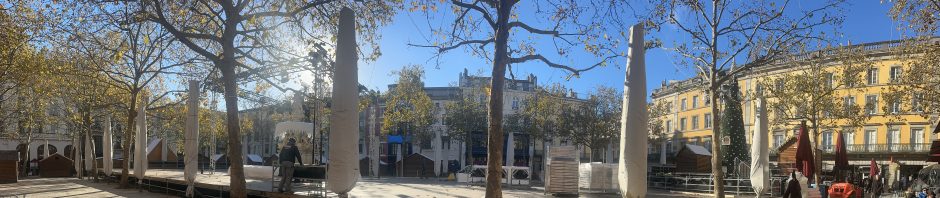
The official reopening is scheduled for May 8th just in time for the re-opening of the terrasses of the bars and bistrots on May 19th. The 10 days are needed to set up all the tables and chairs within the new layouts. Question: do the bars and restaurants also have new furniture?
▫️ MUSICOF 1969
Another number 1 in France at that time.
🎶 / 🎶 / 🎶
▫️ SATIRE
▫️ NEWS FROM ACROSS THE POND 🇺🇸
▫️ WEATHER
Quite a bit of a downturn compared to yesterday but apperently it is much nicer at the coast and therefore this is were we are heading shortly.